


New here? Welcome! We’re working-class travelers, history lovers, digital nomads, Portuguese residents, and many others — building the clearest guide to Portugal’s new citizenship exam (the TNIC) and learning about Portugal along the way, one issue at a time. It’s as much about getting to learn and really know and appreciate Portugal — its history, its customs, and culture — as it is about passing a citizenship exam.
If you’re learning about Portugal, preparing for residency or eventual naturalization — as I am — subscribe free as I prepare alongside you and we will walk through every TNIC exam topic, week by week.
This issue closes a three-issue arc on how Portugal became — and stayed — a country:
Part 1 — The Founding of Portugal (Issue 06) → Part 2 — The Age of Discoveries (Issue 07) → Part 3 — The Iberian Union & Restoration (you are here — Issue 08).
The short version
On 4 August 1578 a 24-year-old Portuguese king led an army into Morocco and never came back. Two years later his uncle — a celibate cardinal serving as caretaker king — also died, and Portugal had no clear heir. Known as the Crisis of 1578-1580. Philip II of Spain had the strongest claim, the biggest army, and the most silver. He took the crown.
For sixty years Portugal was ruled by Spanish Habsburgs. Then, on the morning of 1 December 1640, about forty Portuguese nobles (The 40 Conjured) walked into the royal palace in Lisbon, killed the Spanish secretary of state, threw him out of a window, and proclaimed a Portuguese duke as king. The war that followed took twenty-eight years.
Ninety years, three kings of a foreign dynasty, two changes of crown, one war. You don’t need every battle to follow it.
Four phases and four dates carry the whole era.
What the Union and the Restoration actually were
Four phases hold the whole ninety years. Sort the names and dates into these four buckets and the era falls into place:
CRISIS — Alcácer Quibir and the Cardinal-King. On 4 August 1578 King D. Sebastião was killed at the Battle of the Three Kings near Ksar el-Kebir in Morocco, along with most of the Portuguese nobility. The throne passed to his great-uncle, the 66-year-old Cardinal D. Henrique, who died on 31 January 1580 without naming a successor.
UNION — the Pacto de Tomar. Philip II’s army, under the Duke of Alba, defeated D. António’s forces at the Battle of Alcântara on 25 August 1580. On 16 April 1581 Philip swore an oath at the Convento de Cristo in Tomar and was acclaimed as Filipe I of Portugal. The deal — twenty-five chapters known as the Pacto (or Estatuto) de Tomar kept Portugal legally separate: Portuguese laws, Portuguese language, Portuguese currency, Portuguese-only administration of the empire. A union of crowns, not a conquest.
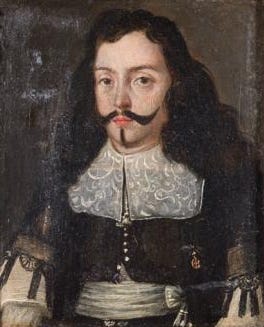
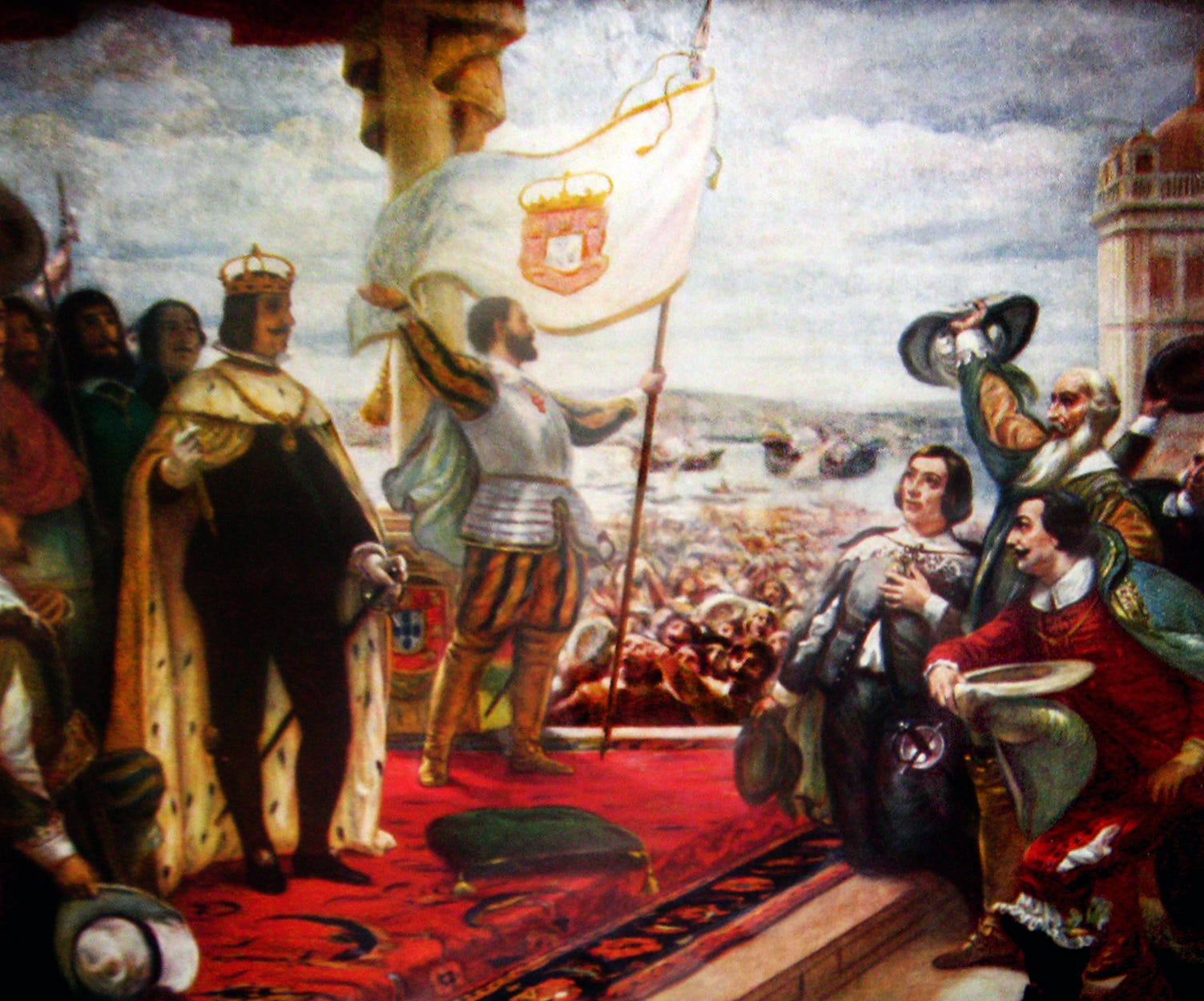
REVOLT — 1 December 1640, the Paçto da Ribeira. By 1640 the Pacto was breaking. Spanish wars had dragged Portugal into fights against the Dutch and the English, who in turn attacked Portuguese possessions in Asia and Brazil. New taxes were imposed; the cortes stopped being called. About forty conspirators stormed the royal palace in Lisbon, shot the Spanish secretary of state Miguel de Vasconcelos, and proclaimed João, 8th Duke of Braganza, as King D. João IV (the Restorer: 1604-1656). He was formally acclaimed on 15 December 1640. The House of Braganza would rule Portugal until the 1910 republic — the last royal dynasty Portugal ever had.
PEACE — the Tratado de Lisboa (The Treaty of Lisbon). Twenty-eight years of war followed the coup. Portuguese forces, aided by English and French alliances, won the decisive battles at the Linhas de Elvas (1659), Ameixial (1663) and Montes Claros (1665). The Treaty of Lisbon, signed at the Convento de Santo Elói on 13 February 1668 and mediated by England, ended hostilities. Spain returned the town of Olivença; Portugal conceded Ceuta. Portuguese independence was recognized.
Two things you won’t hear in the 1 December speeches
First: the king did not come back, but the myth did. D. Sebastião’s body was never conclusively identified at Alcácer Quibir. Within a generation, popular belief held that he would return on a misty morning to restore the kingdom — Sebastianismo, Portugal’s most durable political myth, was used to legitimize the Restoration in 1640 and still surfaces in Portuguese music, poetry and politics into the twentieth century.
Second: the Restoration War was paid for by Brazilian sugar — and the Brazilian sugar economy ran on enslaved African labor. Portuguese forces also expelled the Dutch from Brazil in 1654 as part of the same war effort. The independence story and the slavery story are the same story. Naming this plainly is part of knowing the period.
Why it matters
These ninety years are the reason modern Portugal feels the way it does about its borders, its independence, and its Iberian neighbour. They are also the period that produced its most enduring cultural myth and one of its most quietly observed national holidays.
Sort the era by phase, not by king.
Whether you are studying for the TNIC exam, planning a weekend in Tomar or Vila Viçosa, or just trying to understand why Portugal and Spain are not the same country, the four phases hold.
Alcácer Quibir and the Cardinal-King’s death are CRISIS. The Pacto de Tomar is UNION. The Paço da Ribeira coup is REVOLT. The Treaty of Lisbon is PEACE.
And one civic payoff: 1 December — the Dia da Restauração da Independência (Portugal Independence Day)— is one of Portugal’s four civic-history national holidays. It sits alongside 25 April (Liberty Day, 1974), 10 June (Day of Portugal, Camões and the Portuguese Communities), and 5 October (Republic Day, 1910). Instituted as a holiday in 1910, suppressed in 2012 during the austerity programme, and restored in 2016. Anyone learning Portugal — whether as a citizen-to-be, a long-term resident, or a curious traveler — will eventually meet all four.
Getting value from this? This is exactly how we cover all five exam themes in our practice exams and study materials— real sources, detailed oriented. Click below to get on the waiting list to be the first to know when practice exams and study materials are available.
Five things to remember
The ninety years were a four-phase sequence, not a chaos of kings. CRISIS (Alcácer Quibir 1578 + Cardinal-King 1580), UNION (Pacto de Tomar 1581), REVOLT (1 December 1640), PEACE (Tratado de Lisboa 1668).
Four dates carry the whole era. 1578 (the king dies in Morocco), 1581 (Philip II becomes Filipe I at Tomar), 1640 (the December coup), 1668 (Spain recognizes the independence).
The Pacto de Tomar was a conditional union, not a conquest. Twenty-five chapters guaranteed Portuguese laws, language, currency, and empire-administration. The slow erosion of those terms across sixty years is the proximate cause of the 1640 revolt — a useful reminder that paper promises age.
The House of Braganza was Portugal’s last royal dynasty. Founded as a ducal house in 1442, royal from 1 December 1640 with D. João IV, ruled until 1910 — 270 years, seventeen kings and two queens, every Portuguese monarch you can name born or married into this family.
1 December is one of Portugal’s four civic-history national holidays. Dia da Restauração da Independência sits with 25 April, 10 June and 5 October. Instituted 1910, suppressed 2012, restored 2016 — itself a small story about how a country chooses what to remember.
Practice it
Three quick questions below, useful whether you’re prepping for the TNIC or just want to test what stuck. The full answer key is on the companion subscriber page; subscribe (it’s free) at the bottom of this post to see how you did.
1. Which of these events of the Iberian Union & Restoration happened FIRST?
(a) The Treaty of Lisbon recognises Portuguese independence
(b) Philip II is acclaimed as Filipe I at the Cortes de Tomar
(c) The Battle of Alcácer Quibir in Morocco
(d) The Duke of Braganza is proclaimed king at the Paço da Ribeira
2. What was the Pacto de Tomar (1581)?
(a) A military surrender after the Battle of Alcântara
(b) The treaty that ended the Restoration War
(c) Twenty-five chapters guaranteeing Portuguese laws, language, currency, and empire-administration under Philip II
(d) The papal bull recognizing the new dynasty
3. What is commemorated on 1 December in Portugal?
(a) The Carnation Revolution of 1974
(b) The proclamation of the Portuguese Republic in 1910
(c) The death of Luís de Camões
(d) The Restoration of Portuguese Independence in 1640
How do you think you did without going up in this issue to find the answers? Want the answer key for all the questions in all of our issues? Click below to get them, it’s free.
The Portugal Civics Issue is a free weekly guide to the country of Portugal — its history, its civics, and the new TNIC citizenship exam. Next Sunday: Issue 09 — The Flag, the Quinas & “A Portuguesa” — Themes 2 & 3: Culture & National Symbols.
The work continues.
— Chris, Aspiring Lusitano
Sources and Verifications
• Battle of Alcácer Quibir (4 August 1578): Infopédia: Batalha de Alcácer-Quibir. Primary chronicle — Jerónimo de Mendonça, Jornada de África (1607), Biblioteca Nacional de Portugal. King D. Sebastião killed; succession crisis follows.
• Death of Cardinal-King D. Henrique (31 January 1580) and the three claimants: Infopédia: Crise de 1578–1580; RTP Ensina: Os dilemas de D. Henrique. Three claimants — D. Catarina, D. António Prior of Crato, Philip II — all grandchildren of D. Manuel I.
• Battle of Alcântara (25 August 1580): Infopédia: Invasão Espanhola de 1580. The Duke of Alba’s army defeats forces loyal to D. António, Prior of Crato.
• Cortes de Tomar and the Pacto de Tomar (16 April 1581): Convento de Cristo (DGPC); RTP Ensina: A aclamação de Filipe I e o Pacto de Tomar. Twenty-five chapters; Portuguese laws/language/currency/empire-administration guaranteed; Philip II raised as Filipe I.
• Coup of 1 December 1640 at the Paço da Ribeira: RTP Ensina: A Restauração de 1640. About forty Portuguese conspirators; Miguel de Vasconcelos shot and thrown from a window of the Paço da Ribeira.
• Formal acclamation of D. João IV (15 December 1640); House of Braganza as royal dynasty: Mensageiro de Bragança: D. João IV, o Restaurador; Infopédia: Casa de Bragança. Ducal house founded 1442; royal dynasty 1640–1910, seventeen kings and two queens.
• Tratado de Lisboa (13 February 1668): Arquivo Nacional Torre do Tombo: Tratado de Paz de 1668; Portal Diplomático MNE: Espanha — Relações Diplomáticas. Signed at the Convento de Santo Elói (Lisbon); mediated by England (Duke of Sandwich); thirteen articles; Olivença returned to Portugal, Ceuta conceded to Spain.
Images
• Image 1- Portrait of D. João IV
Placement: Within the body of the issue, alongside the section introducing D. João IV as the Duke of Braganza proclaimed king on 1 December 1640. Works as a sidebar portrait to anchor the reader on who he was.
Source file: File:D. João IV de Portugal (Museu de Évora, ME20).png — Wikimedia Commons
.png)
Citation: Anonymous Portuguese painter, 17th century. Oil on canvas. Museu de Évora, Évora, Portugal (inventory ref. ME20). Digital reproduction published on Wikimedia Commons.
License: Public domain — 17th-century work; copyright expired. Confirm exact license string on the Wikimedia file page before publishing. Note: the physical painting belongs to the Museu de Évora; the digital reproduction on Wikimedia Commons is released under the terms listed on the file page. This work is in the public domain in its country of origin and other countries and areas where the copyright term is the author's life plus 100 years or fewer.
• Image 2 — Acclamation of D. João IV
Source file: File:Joao IV proclaimed king.jpg — Wikimedia Commons

Citation: Artist unknown (19th-century Romantic-era painting depicting the proclamation of D. João IV, Duke of Braganza, as King of Portugal at the Paço da Ribeira, 1 December 1640). Published on Wikimedia Commons.
License: Public domain — 19th-century painting; copyright expired. This work is in the public domain in the United States because it was published (or registered with the U.S. Copyright Office) before January 1, 1931.