

The Flag, the Quinas 🛡️ & “A Portuguesa”
Issue No. 9 · Pillar 2: Culture and Nation- What every element of Portugal's flag and anthem means, and how they became the Republic's national symbols in 1911. 🛡️

New here? Welcome! We’re working-class travelers, history lovers, digital nomads, Portuguese residents, and many others — building the clearest guide to Portugal’s new citizenship exam (the TNIC) and learning about Portugal along the way, one issue at a time. It’s as much about getting to learn and really know and appreciate Portugal — its history, its customs, and culture — as it is about passing a citizenship exam.
If you’re learning about Portugal, preparing for residency or eventual naturalization — as I am — subscribe free as I prepare alongside you and we will walk through every TNIC exam topic, week by week.
If you are here just to Practice It there are three quick questions at the bottom, useful if you are prepping for the TNIC are wanting to test your current knowledge about Portugal.
The short version
Look at the Portuguese flag and you are reading a sentence the country wrote about itself in 1911 — three years before the First World War, one year after it stopped being a monarchy. Green where there had never been green. A medieval shield. A navigator’s instrument. And five small blue shields holding a thousand-year-old argument.
Article 11 of Portugal’s Constitution names the flag and the anthem by article — not by implication, but explicitly, by name. Under Lei Orgânica 1/2026, which governs the TNIC citizenship exam, knowledge of Portugal’s national symbols is a tested requirement. This is not soft culture; for the TNIC reader, it is examinable fact with clean hooks: two objects, a handful of dates, one decree.
For anyone living in Portugal, the flag flies on every public building on Sundays and holidays under Decreto-Lei 150/87. Insulting it in public is a crime under Article 332 of the Penal Code, punishable by up to two years. The symbols are protected the way the institutions are. For the civic-curiosity reader, the flag packs four centuries into one rectangle. By the end of this issue, you will be able to read every layer.
The Flag the Republic Built
The green-and-red combination was not ancient Portugal’s colors. Historic royal Portugal flew blue and white. The verde-rubro (green-and-red) scheme traces to the failed republican revolt of 31 January 1891 in Porto and was carried again at the Revolution of 5 October 1910 that ended the monarchy.
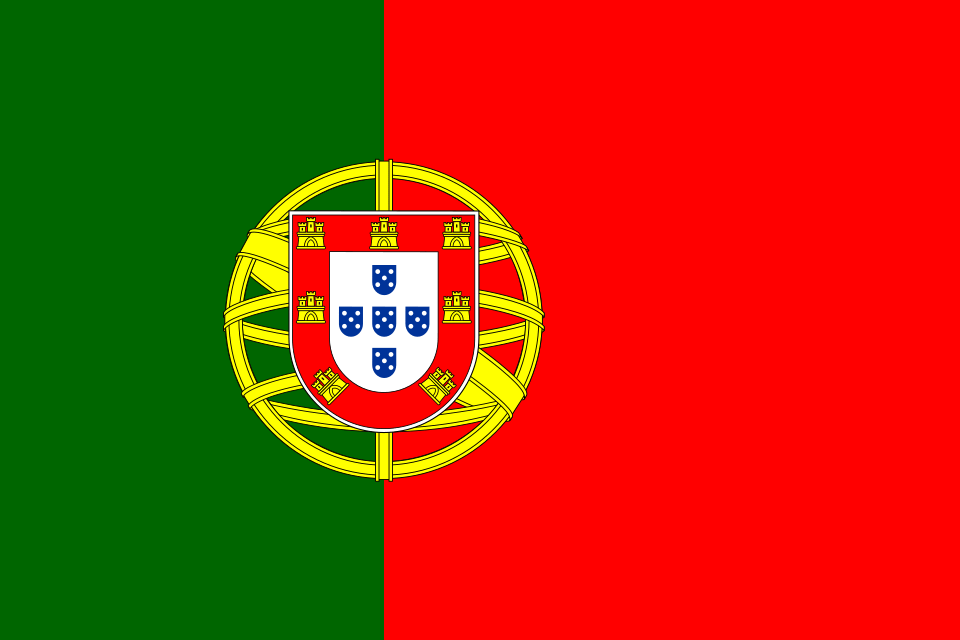
Ten days after the revolution, on 15 October 1910, the Provisional Government named a commission to design a national flag. Its members: the painter Columbano Bordalo Pinheiro, the writer Abel Botelho, and the journalist-politician João Chagas. The government approved the design on 29 November 1910.
Then, on 19 June 1911, the National Constituent Assembly issued the decree that made the flag official — the same decree, in the same act, that named “A Portuguesa” the national anthem. The detailed specifications for the flag’s proportions followed on 30 June 1911.
The flag was designed in 1910; it became law in 1911. Something to remember for the TNIC exam.
What the Sphere and the Shield mean
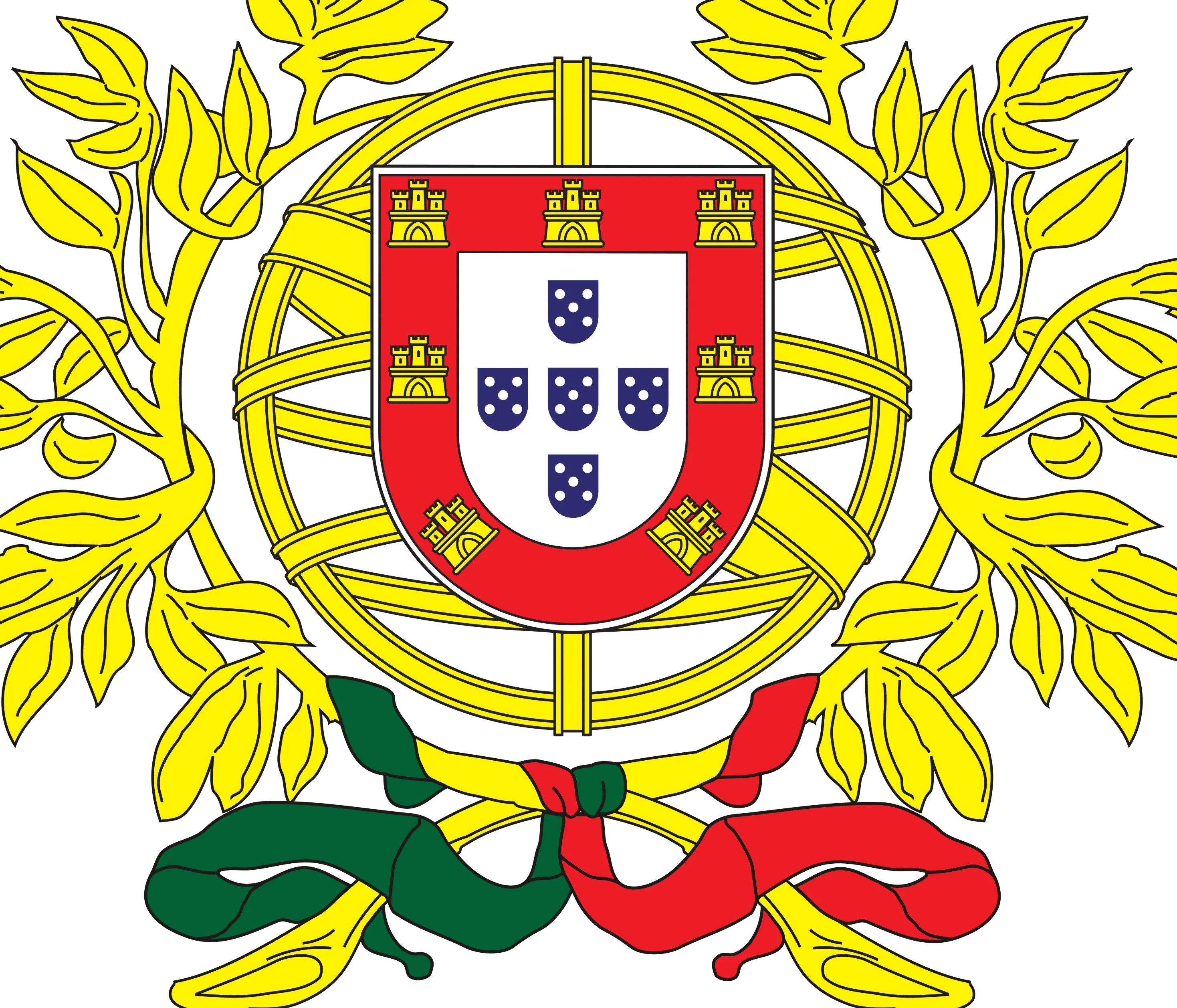
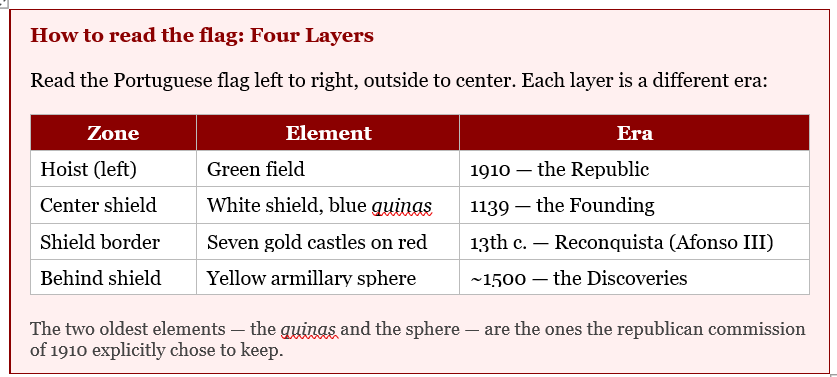
The commission did not leave its choices unexplained. In its own words, the Manueline armillary sphere — the navigator’s instrument in gold behind the central shield — is “the eternal standard of our adventurous genius” (padrão eterno do nosso génio aventureiro). It is a direct reference to the Age of Discoveries and the reign of Manuel I.
The white shield with five blue escudetes is the emblem “of the founding of the nationality” (da fundação da nacionalidade). The commission that built a new republic chose to keep its two oldest-looking elements — and told us exactly why.
The Quinas
The five small blue shields at the center of the Portuguese coat of arms are the quinas (singular: quina). Each carries five white bezants (besantes) arranged in a cross; the five shields themselves form a cross. Tradition ties them to the Lenda de Ourique — the founding battle of 1139, in which Afonso Henriques is said to have had a vision of the five wounds of Christ before defeating the Moors. Historians date the story to 15th- and 16th-century chronicles, not the 12th century. The legend came centuries after the fact.
The seven gold castles on the red border of the coat of arms are often misattributed to Afonso Henriques. They are not his. Castles were added to the coat of arms under Afonso III in the 13th century — a full century after Afonso Henriques — but the specific count of seven was not fixed until the second half of the 16th century, well after Afonso III’s reign.
“A Portuguesa” — a protest song that outlasted its target
“A Portuguesa” was not written as a celebration. Music by Alfredo Keil, lyrics by Henrique Lopes de Mendonça, it was written in early 1890 in direct response to the British Ultimatum of 11 January 1890 — London’s demand that Portugal abandon its claim to the territory between Angola and Mozambique (the “Pink Map”). The song became the march of the 31 January 1891 republican revolt in Porto. The monarchy banned it. The 1910 revolution revived it, and the 1911 decree made it the national anthem.
One more date: the anthem was adopted in 1911, but the official orchestral version was not fixed until 1957, by a Council of Ministers resolution published 4 September 1957 in the Diário do Governo, with the arrangement by Frederico de Freitas. The anthem existed for 46 years without an official musical version.
Denmark’s flag, and why the comparison matters
Portugal is not the only country whose flag carries a medieval miracle. Denmark’s Dannebrog — the world’s oldest national flag in continuous use — comes with its own founding legend: it fell from the sky during the Battle of Lyndanisse on 15 June 1219, turning a losing Danish crusade into victory. Modern historians in both countries treat the miracle as a later invention. The Dannebrog story appears first in 16th-century sources; the Ourique apparition in 15th- and 16th-century chronicles. Both stories were written centuries after the events they describe.
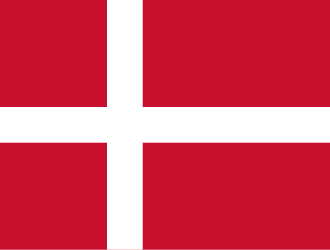
The instructive difference: Denmark built its entire flag on the legend. Portugal folded its legend into one corner — the five quinas — and surrounded it with datable history: Reconquista castles, a Manueline sphere, republican colors chosen in 1910. Denmark let the myth be the flag. Portugal made the myth one stanza of a longer, documented sentence.
Getting value from this? This is exactly how we cover all four exam pillars in our TNIC practice exams and study materials— real sources, detailed oriented. Click below to get on the waiting list to be the first to know when practice exams and study materials are available.
Practice it
Three quick questions below, useful whether you’re prepping for the TNIC or just want to test what stuck. The full answer key is on the companion subscriber page; subscribe (it’s free) at the bottom of this post to see how you did.
1. The five small blue shields at the centre of the Portuguese coat of arms — also the nickname of the national football team — are called:
(a) A esfera armilar (the armillary sphere)
(b) As quinas
(c) Os sete castelos
(d) Os besantes
2. What do the seven gold castles on the Portuguese coat of arms represent, and when were they fixed?
(a) Castles taken by Afonso Henriques at the Battle of Ourique in 1139
(b) The seven provinces of medieval Portugal
(c) Strongholds taken during the Reconquista, fixed under Afonso III in the 13th century
(d) Seven sea routes established during the Age of Discoveries
3. “A Portuguesa” was written in 1890 as a protest song in direct response to which event?
(a) The Carnation Revolution of 1974
(b) The British Ultimatum of 1890
(c) The proclamation of the Republic in 1910
(d) The Napoleonic invasion of Portugal
How do you think you did without going up in this issue to find the answers? Want the answer key for all the questions in all of our issues? Click below to get them, it’s free.
The Portugal Civics Issue is a free weekly guide to the country of Portugal — its history, its civics, and the new TNIC citizenship exam. Next Sunday: Issue 10 — Pillar 3: Political Organization of the State — How Portugal Is Governed Today.
The work continues.
— Chris, Aspiring Lusitano
SOURCES & VERIFICATION
CONSTITUTION OF THE PORTUGUESE REPUBLIC
● Article 11 — National Flag and Anthem — Constitution of the Portuguese Republic, Article 11. Full consolidated text via DRE.pt — Constituição da República Portuguesa. Establishes the flag and anthem by name under supreme law.
NATIONAL FLAG — DESIGN, HISTORY, DECREE
● Flag design commission (1910) and 29 November 1910 approval — Presidency of the Republic, Symbols — Bandeira Nacional. presidencia.pt — Bandeira Nacional. Names commission members (Columbano Bordalo Pinheiro, Abel Botelho, João Chagas), approval date, and the commission’s own description of the armillary sphere as “padrão eterno do nosso génio aventureiro.”
● Decree of 19 June 1911 (flag and anthem made official) — National Constituent Assembly decree, 19 June 1911. Scanned document: presidencia.pt — Decreto de 19 de Junho de 1911 (PDF). Confirms both the national flag and “A Portuguesa” as national symbols in a single act. Proportions decree: 30 June 1911.
● Decreto-Lei 150/87 — Flag display on Sundays and public holidays — Decreto-Lei n.° 150/87, published in Diário da República. Scanned document: presidencia.pt — Decreto-Lei 150/87 (PDF). Mandates display of national flag on public buildings on Sundays and national holidays.
COAT OF ARMS — QUINAS AND OURIQUE LEGEND
● Quinas and national symbols — Presidency of the Republic — Presidency of the Republic, Símbolos Nacionais. presidencia.pt — Símbolos Nacionais. Overview of all national symbols including flag, coat of arms, anthem, and their legal basis.
● Seven castles attributed to Afonso III (not Afonso Henriques) — Infopédia — Armas de Portugal. Porto Editora encyclopedic reference. Cross-checked against Presidency of the Republic symbols page. The castles were added to the coat of arms in the reign of Afonso III (r. 1248–1279), a full century after Afonso Henriques (r. 1139–1185).
NATIONAL ANTHEM — “A PORTUGUESA”
● Anthem — origin, composers, 1911 adoption — Presidency of the Republic, Hino Nacional — “A Portuguesa.” presidencia.pt — Hino Nacional. Details Alfredo Keil (music) and Henrique Lopes de Mendonça (lyrics), the British Ultimatum of 11 January 1890, the role of the 31 January 1891 revolt, and adoption by 19 June 1911 decree.
● Official orchestral version fixed 4 September 1957 — Council of Ministers resolution, published Diário do Governo, 4 September 1957. Arrangement by Frederico de Freitas. Referenced in Presidency of the Republic hino page (above).
CROSS-CULTURAL REFERENCE — DENMARK’S DANNEBROG
● Dannebrog — Battle of Lyndanisse, 15 June 1219; first appears in 16th-century sources — Danish Royal House (kongehuset.dk) and the National Museum of Denmark. The legend of the Dannebrog falling from the sky at the Battle of Lyndanisse (15 June 1219) is documented, with the note that the earliest written sources date to the 16th century, not the 13th.
PENAL CODE — PROTECTION OF NATIONAL SYMBOLS
● Penal Code Article 332 — insulting national symbols — Código Penal Português, Artigo 332.° (Ultraje de símbolos nacionais e regionais). Up to two years’ imprisonment. Full consolidated text available via DRE.pt — Código Penal.
TNIC EXAM LEGISLATION
● Lei Orgânica 1/2026 — TNIC citizenship exam requirement — Lei Orgânica n.° 1/2026, in force 19 May 2026. Governs the TNIC Portuguese citizenship exam; establishes national symbols as a tested domain. DRE.pt — Lei Orgânica 1/2026.
Images
Image 1 — Portuguese National Flag (current design, 1911)
Placement: Hero image at the top of the issue, immediately following the title.
Source file: Wikimedia Commons — Flag of Portugal.svg

Citation: Columbano Bordalo Pinheiro (original design, 1910); SVG render by Wikimedia contributors. Published on Wikimedia Commons.
License: Public domain. The flag design is a government symbol and is in the public domain. SVG file on Wikimedia Commons is also released under CC0 / public domain. Free for all uses including commercial without attribution required.
Image 2 — Coat of Arms of Portugal (Armas de Portugal)
Placement: Within the body, adjacent to the section “The quinas — legend and exam trap.” Annotated version preferred if available (labeling the quinas, castles, and sphere separately).
Source file: Wikimedia Commons — Coat of arms of Portugal.svg

Citation: Wikimedia Commons contributors. SVG version of the official Portuguese coat of arms.
License: Public domain. The coat of arms is a government symbol in the public domain. SVG file released under CC0. Free for all uses.
Image 3 — Danish flag (Dannebrog) — for cross-cultural comparison section
Placement: In the “Denmark’s flag, and why the comparison matters” section. Side-by-side layout with the Portuguese flag preferred if space permits. Otherwise a standalone Dannebrog image below the section heading.
Source file: Wikimedia Commons — Flag of Denmark.svg

Citation: Public domain SVG render by Wikimedia contributors. The Dannebrog design dates to the medieval period.
License: Public domain. Government symbol; SVG on Wikimedia is CC0. Free for all uses.
END