

The Constitution of 1976: How Portugal Wrote a Country in Twelve Months
Issue No. 4 · Theme 1: History

A year and a day after the soldiers in Lisbon swapped rifles for carnations, Portuguese voters lined up at the polls and elected 250 strangers. They were not electing a government. They were electing a Constituent Assembly with one job: write us a country. Turnout was above 91 percent — the highest in modern Portuguese history. The strangers met for twelve months in a building still wired with the nerves of revolution. What they produced is still the law of Portugal today.
The room had a military veto
The Constituent Assembly that opened in June 1975 did not walk into an empty room. Two months earlier, on 11 April 1975, the Movimento das Forças Armadas — the military officers who had toppled the Estado Novo the year before — had signed a Pact with the political parties.
The First MFA-Parties Pact preserved a large institutional role for the military: a Conselho da Revolução with quasi-judicial review over whatever the civilians wrote. The drafters arrived knowing the soldiers were still in the building.
On 25 November 1975 a leftist faction inside the military attempted a coup. It failed. Three months later, in February 1976, a Second MFA-Parties Pact rebalanced the architecture, scaling back military veto power. The drafters then voted. On 2 April 1976, in session number 131, the Constituição da República Portuguesa was approved in its final global vote.
The document committed Portugal to extraordinary things. It described the nationalizations of the post-revolution months as “irreversible conquests of the working classes.” It declared a stated direction of travel toward socialism. And it set its own effective date with calendar poetry: the Constitution entered into force on 25 April 1976 — the second anniversary of the revolution. The drafters chose the date deliberately. They were writing the country that April 25 had made possible.
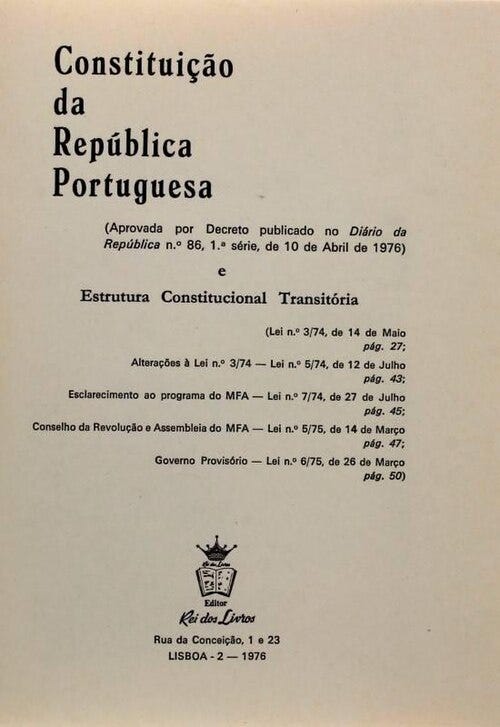
Image: Constituição da República Portuguesa, 10 April 1976 (cover page).
Credit: Editora Rei dos Livros, via Wikimedia Commons, CC BY-SA 4.0.
The court Portugal forgot about
Here are the details most Portuguese citizens — and most future exam-takers — may never learn:
The Constitutional Court that today rules on every nationality case, every election, every fundamental-rights dispute did not exist in the original 1976 Constitution. Constitutional review for the first six years of the democratic Republic — from 1976 to 1982 — was performed by the Conselho da Revolução. A body of military officers. The Republic was a parliamentary democracy with a military constitutional court for its first six years, and almost no one alive in Portugal today remembers that.
The civilian Tribunal Constitucional that we now treat as a permanent feature of Portuguese life was created by the First Constitutional Revision in 1982 — the same revision that abolished the Conselho da Revolução and finished demilitarizing the Republic. There have been seven revisions in total: 1982, 1989, 1992, 1997, 2001, 2004 and 2005. Each one adjusted the country a little further away from the room the drafters had been writing in.
Do you know the TNIC Practice Exams and Study Materials are coming?
When Portugal’s implementing regulations publish for the new civics exam — expected later in August 2026 — the official TNIC civic knowledge exam becomes real. We’re building dedicated practice exams and study materials so you can walk into that room prepared. Want to be first to know when it launches, and get free study materials along the way?
Join the TNIC Practice Exams waitlist
Already subscribed to this Substack? You’re ahead. Every issue between now and launch is building the knowledge base the exam will draw from. Keep reading — you’re already preparing.
If you aren’t, subscribe free.
Why this history matters — whether you’re testing, staying, or just learning
Theme 4 of the TNIC tests the political organization of the Portuguese State. Theme 5 tests fundamental rights and duties. Both themes trace back to specific articles in the 1976 Constitution. If you’re preparing for the test, you cannot really learn either theme without learning the document itself.
But the Constitution is not only an exam topic. If you live in Portugal on a residency visa and never plan to naturalize, the rights enumerated in Title II — personal liberty, due process, religious freedom, the right to be informed in your own language during a criminal proceeding — are rights you exercise every day. Article 15 explicitly extends most fundamental rights to non-citizens lawfully resident in Portugal. The Constitution drafted in 1976 is the floor underneath your residency card too.
And if you are reading from elsewhere — diaspora, descendant, civic-curious — the Constitution is what answers the question every outsider eventually asks: what makes Portugal Portugal, beyond the food and the coast? It is this document. A republic written by people who had just lived through forty-eight years of the alternative.
TNIC Exam Quick Takes — 3 facts the exam will test
· The Constituent Assembly that drafted the Constitution was elected on 25 April 1975 — the one-year anniversary of the Carnation Revolution. Turnout was above 91%.
· The Constitution was approved on 2 April 1976 (session 131) and entered into force on 25 April 1976 — the second anniversary of the Revolution. It has been revised seven times: 1982, 1989, 1992, 1997, 2001, 2004, 2005.
· Article 288 lists fourteen entrenched clauses — matters no future revision can change. They include the republican form of government, universal suffrage, the rights of workers, and the autonomy of the Açores and Madeira.
→ Seeing unfamiliar terms in these issues? Bookmark the TNIC Exam Preparation Glossary— your weekly reference guide for key terms to prepare and know in all our issues.
This week’s recap — four things to hold onto
· The 1976 Constitution was written by a 250-member Constituent Assembly, elected on 25 April 1975 with 91% turnout — exactly one year after the Carnation Revolution.
· The room had a military veto. The MFA-Parties Pacts (April 1975, February 1976) framed what the drafters were allowed to write, and a body of military officers — the Conselho da Revolução — performed constitutional review until 1982.
· The Constitution entered into force on 25 April 1976, the second anniversary of the Revolution. Seven revisions later, the document is still the law of Portugal.
· Article 288 lists the fourteen entrenched clauses that no future revision may touch. They are the reason a Portuguese majority cannot, by ordinary politics, undo the Republic.
Practice It
1. How long after the Carnation Revolution was the new Constitution adopted? (a) About 6 months (b) About 10 years (c) About 2 years
2. Which court rules on whether laws comply with the Constitution? (a) The Constitutional Court (Tribunal Constitucional) (b) The Supreme Court (c) The Court of Auditors
3. In what year was Portugal’s current Constitution adopted? (a) 1974 (b) 1976 (c) 1982
4. What public institution, rooted in the 1976 Constitution, provides universal healthcare? (a) The SNS (Serviço Nacional de Saúde) (b) AIMA (c) The CIPLE
How did you do? The answers — to this issue and every future issue’s questions— are free on our Practice Answers page to all subscribers. No need for a paid subscription, just hit FREE instead.
Looking ahead on the calendar— Portugal Day, June 10
Three days after this issue lands, Portugal observes its national day: *Dia de Camões, de Portugal e das Comunidades Portuguesas*. It marks the death of Luís de Camões — Portugal’s national poet — on 10 June 1580, and it is the day Portugal claims its global Portuguese-speaking community as part of itself.
Whether you’re preparing for an exam where Camões will appear, living in Portugal as a resident, or reading from the diaspora — June 10 is the day. And The Portugal Civics Issue will have something to commemorate the day.
Start here: Issue 01 — The Five Themes | Glossary of TNIC Terms | Compare with free apps
Next Sunday — Issue 5: Estado Novo under Salazar
We have spent three weeks looking at what April 25 produced — the revolution, the people, the constitution. Next week we look at what April 25 ended.
The Estado Novo governed Portugal for forty-eight years. To understand why the drafters of the 1976 Constitution wrote Article 288 the way they did, you have to understand the regime that taught them what an unrestrained state actually looks like. Next Sunday, the Estado Novo: how it took power, how it held it, and what it cost.
Subscribe free if you haven’t yet — Issue 5 is the dictatorship the entrenched clauses were written against.
The work continues. — Chris, Aspiring Lusitano
For Your Family & Its Importance
A note on this section: the civic exam is for adults — your children aren’t required to take it. But many of us are raising young people who will become Portuguese citizens alongside us, kids who grew up outside Portugal and never sat in a classroom where this history was taught. Sharing what we’re learning at the dinner table is one way to pass something real to them — a courtesy to our children, not just preparation for ourselves. It also brings families a little closer to share something everyone is working toward together, even when the stakes are different for each person.
I’m doing it with my two teenage sons now. If it fits your family, put it in the toolkit. If not — no pressure. Either way, the goal here is bigger than a test: not to be a naturalized citizen on paper, but an educated, respectful, and humble citizen of not just Portugal, but the EU at large. That’s worth passing along, at any age.
So here is a youth friendly version of what you just read, if you’d like to share it at the dinner table, in the car, or on the bus or train.
A constitution is a country’s promise to itself. Portugal’s promise was written one year after the Carnation Revolution. Voters elected 250 people whose only job was to write the rules — what the government can do, what it cannot do, what every person who lives in Portugal is allowed to count on. They worked for twelve months. Some of their rules can be changed by future governments. But fourteen of them — the most important ones — were written so no future government could change them, no matter what.
Three questions:
· What is a constitution to you? Why do you think Portugal needed to write a new one?
· If you had to write down one rule for a new country that could never be changed, what would be that rule? And why?
· Why do you think the people who wrote Portugal’s constitution didn’t trust the military to give the people back the power?
Send us their answers — we’d love to share a few next time!
Sources
All URLs verified before publication.
Primary
· Diário da República — Decreto de Aprovação da Constituição, de 10 de Abril de 1976 — diariodarepublica.pt/dr/detalhe/decreto-aprovacao-constituicao/1976-502635
· Constituição da República Portuguesa — original gazette PDF, DR I-A, n.º 86, 10 April 1976, pp. 738–775 — files.dre.pt/1s/1976/04/08600/07380775.pdf
· Assembleia da República — A construção da Democracia (1974–1976) — parlamento.pt/Parlamento/Paginas/construcao-democracia_1974-1976.aspx
· Constitution of the Portuguese Republic — Seventh Revision (English), Assembleia da República — parlamento.pt/sites/EN/Parliament/Documents/Constitution7th.pdf
Secondary (corroboration, not in-text citation)
· Os pactos MFA-Partidos e as origens do sistema de governo da Constituição de 1976 — UCP Repositório
· Centro de Documentação 25 de Abril, Universidade de Coimbra — cd25a.uc.pt
· Comissão Comemorativa 50 Anos do 25 de Abril — 50 anos da Constituição da República Portuguesa (1976–2026) — 50anos25abril.pt/historia/50-anos-da-constituicao-da-republica-portuguesa-1976-2026/
End