

⚖️Your Rights and Duties as a Portuguese Citizen
📜 Legal residents in Portugal carry almost the full set of constitutional rights and duties — years before they naturalize. Naturalization adds less then you'd think. Issue 11.

New here? We’re working travelers, not professors — building the clearest English-language guide to Portugal’s new citizenship exam (the TNIC), one Sunday at a time. Today we open the Constitution’s own definition of what you’re signing up for: not just rights, but the duties bundled with them.
If you’re preparing to become Portuguese, like I am, subscribe free and I’ll walk the whole TNIC exam with you, week by week.
If you are here just to Practice It, there are three quick civics exam questions on this issue at the bottom.
The Short Version
The Constitution of the Portuguese Republic does something most rights charters don’t: it puts your rights and your duties in the same sentence. Part I is literally titled Direitos e Deveres Fundamentais — Fundamental Rights and Duties — and Article 12 states it as one principle, not two lists: “All citizens enjoy the rights and are subject to the duties enshrined in the Constitution.”
Here’s the part that surprises most naturalization-track readers: Article 15 extends nearly that whole bundle — rights and duties both — to foreigners and stateless people who are already legal residents. So the useful question for this issue isn’t “what do I gain by becoming Portuguese.”
It’s narrower: what’s actually still missing if you’re already living here legally, and what does the Constitution ask of you in exchange for closing that gap.
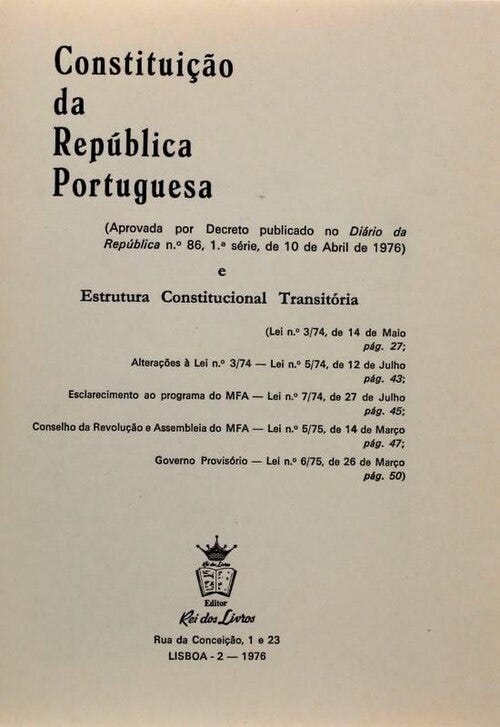
Rights and duties, named together from the start
Article 12 opens Part I of the Constitution and sets the frame for everything that follows: nothing in the rights chapters is presented as free-standing. Article 13 is the equality guarantee that rides alongside it — no one may be favored, harmed, deprived of a right, or exempted from a duty because of ancestry, sex, race, language, territory of origin, religion, political or ideological conviction, education, economic situation, or social condition.
Two articles, one design choice: Portugal’s Constitution doesn’t let you pick rights off a menu without the duties that come stapled to them.
What naturalization actually adds — Article 15
If you’re a foreigner or stateless person legally resident in Portugal, Article 15 already gives you the rights and subjects you to the duties of a Portuguese citizen — with a short, named list of exceptions: political rights, access to public office that isn’t predominantly technical, and any rights or duties the Constitution reserves exclusively to citizens.
A further clause gives citizens of Portuguese-speaking (CPLP) countries with permanent residence even more, withholding only the very top offices (President, President of the Assembly, Prime Minister, the presidents of the supreme courts) and service in the armed forces or diplomatic corps.
Read plainly: a legal resident already holds almost the whole bundle. Naturalization’s real addition is political rights — voting for President and Assembly, standing for office — plus non-technical public office and that short reserved-post list.

A duty the Constitution names but doesn’t enforce — Article 49
Every citizen over 18 has the right to vote, barring incapacities set by general law. Article 49 adds a line that catches most readers off guard: “the exercise of the right to vote is personal and constitutes a civic duty.” Portugal doesn’t fine or penalize non-voters the way Belgium or Australia do, there’s no enforcement mechanism attached to this clause, but the constitutional character of the act is duty, not just entitlement.
A duty the Constitution names and does enforce — Article 103
Article 103 sets the fiscal system’s purpose — funding the state and distributing income and wealth fairly — and requires every tax to be created by law, fixing what’s taxed, the rate, any benefits, and taxpayer guarantees. No one can be made to pay a tax that wasn’t created this way, applied retroactively, or collected outside the law. Unlike voting, this duty carries real legal consequences if ignored.
A duty that’s never left the Constitution — Article 276
Article 276 states that defense of the homeland is “a right and fundamental duty of every Portuguese,” with military service regulated by law as to form, voluntary-or-compulsory character, duration, and content.
That duty has never been amended out of the Constitution — Portugal simply suspended compulsory conscription by ordinary law: Lei n.º 174/99, de 21 de setembro set a four-year transition, and by November 2004 the armed forces ran on volunteers only. The constitutional duty is dormant, not gone.
Parents get the pairing too — Article 36
Article 36(5) puts the whole Article 12 principle into a single domestic sentence: “Parents have the right and the duty of education and maintenance of their children.” It’s the clearest one-line example in the entire Constitution of rights and duties paired rather than listed apart.
Why it matters
Lei Orgânica 1/2026 and the Ministry of Justice’s own description of the TNIC name “the rights, duties, and political organization” of citizens as one of the exam’s five subjects (themes) — close to the statute’s own language, not an inference.
For anyone on the naturalization track, Article 15 is the single most useful fact here: if you’re already a legal resident, you hold nearly everything on this list, so knowing what naturalization actually adds (political rights, non-technical public office, a short reserved-post list) beats a general civics lecture on “what rights Portugal has.”
For residents day to day, knowing which duties are enforceable (tax) and which aren’t (voting) prevents both overcompliance anxiety and accidental noncompliance.
Getting value from this? Subscribe. This is exactly how I cover all five exam themes — plain English, fact and source driven, no fluff.
Practice it
Three quick questions below, useful whether you’re prepping for the TNIC or just want to test what stuck on your knowledge of Portugal. The full answer key is on the companion subscriber page; subscribe (it’s free) at the bottom of this post to see how you did.
1. Under Article 15 of the Constitution, what is generally true of foreigners and stateless persons legally resident in Portugal?
(a) They have no constitutional rights until they naturalize
(b) They hold nearly the same rights and duties as Portuguese citizens, with a short list of exceptions
(c) They have full political rights, including the right to vote for President
(d) They are exempt from all duties Portuguese citizens carry
2. Under Article 49, casting a vote in Portugal is legally described as:
(a) An entirely optional act with no legal character
(b) A personal act that also constitutes a civic duty, though nothing punishes those who skip it
(c) Mandatory, with fines for non-voters, as in Belgium
(d) A right reserved only to citizens born in Portugal
3. Which of the following is named in the Constitution as a duty (dever), not simply a right, of Portuguese citizens?
(a) Freedom of the press
(b) Habeas corpus
(c) Paying taxes established by law
(d) Freedom of religion
How do you think you did without going back up into this issue to find the answers? Want the answer key for all the questions in all of our issues?
— it’s free.
The Portugal Civics Issue is a free weekly guide to Portugal’s TNIC citizenship exam. Next Sunday: Issue 12: The 1755 Lisbon Earthquake
If this knowledge is helpful and can be in your future, click here to subscribe.
The work continues.
— Chris, Aspiring Lusitano
SOURCES & VERIFICATION
CONSTITUTION OF THE PORTUGUESE REPUBLIC
● Article 12.º — Princípio da universalidade. diariodarepublica.pt — CRP consolidada, Art. 12.º
● Article 13.º — Princípio da igualdade. diariodarepublica.pt — CRP consolidada, Art. 13.º
● Article 15.º — Estrangeiros, apátridas, cidadãos europeus. diariodarepublica.pt — CRP consolidada, Art. 15.º
● Article 36.º — Família, casamento e filiação. diariodarepublica.pt — CRP consolidada, Art. 36.º
● Article 49.º — Direito de sufrágio. diariodarepublica.pt — CRP consolidada, Art. 49.º
● Article 103.º — Sistema fiscal. diariodarepublica.pt — CRP consolidada, Art. 103.º
● Article 276.º — Defesa da Pátria, serviço militar e serviço cívico. Text verified against O Informador Fiscal (legal-code mirror); official record at diariodarepublica.pt — CRP consolidada (index). A direct per-article dre.pt deep link for Art. 276 could not be resolved this session — see production note.
MILITARY SERVICE
● Lei n.º 174/99, de 21 de setembro (Lei do Serviço Militar) — set the four-year transition that ended compulsory conscription; fully in force by November 2004. diariodarepublica.pt — Lei 174/99
NATIONALITY LAW
● Lei Orgânica n.º 1/2026, de 18 de maio — nationality law in force; names rights, duties, and political organization as TNIC-examinable domains. diariodarepublica.pt — Lei Orgânica 1/2026
Images
● Image 1 — Cover of a 1976 printed edition of the Constituição da República Portuguesa (Editora Rei dos Livros).
Source file: Wikimedia Commons — Constituição da República Portuguesa, de 10 de Abril de 1976.jpg
Citation: Editora Rei dos Livros, via Wikimedia Commons.
License: CC BY-SA 4.0. Attribution required.

● Image 2 — Cover of a Portuguese passport.
Source file: Wikimedia Commons — Portuguese Passport Cover.jpg
Citation: Arenawise, via Wikimedia Commons.
License: CC BY-SA 4.0. Attribution required.
● Image 3 — Wooden ballot box
Source file: Wikimedia Commons — Wooden_ballot_box_-_Smithsonian.jpg
Citation: Smithsonian Institution, via Wikimedia Commons.
License: Public domain. No attribution required.
URL: https://commons.wikimedia.org/wiki/File:Wooden_ballot_box_-_Smithsonian.jpg

END