


New here? We are working travelers, visa holders or visa holders to be, in country residents, future travelers headed to Portugal, or have planned moves to Portugal. We are not professors or historians — but we are building the clearest English-language guide to helping residents, travelers, and exam takers of Portugal’s new citizenship exam (the TNIC). I do this methodically one Sunday at a time. No one left behind on this journey.
Today’s issue: the five legal routes into and toward Portuguese citizenship — three residency visa categories, and two separate paths to nationality itself, straight from the statute and the visa portal, not a relocation blog’s summary of it.
If you’re planning a trip to Portugal, planning on residing there in your future, looking for ways to integrate into Portuguese society or preparing to become Portuguese — as I am — subscribe free to this Substack and we will walk through the five themes (subjects) that are helpful in all things Portuguese and will help prepare you for the TNIC exam, week by week.
If you are here just to Practice It for the future TNIC exam, there are three quick civics exam questions at the bottom of this issue. Scroll down. ▼
The short version
Here’s what I’ve learned and sharing about my residency journey. Getting a residency visa and becoming a Portuguese citizen are two different legal events, years apart. A visa gets you in the door — legal residency. Citizenship is a separate step after that, and the law recognizes more than one way to reach it: the standard residency clock, a shorter clock through marriage, or no clock at all if you can trace it through a Portuguese ancestor. Much of this can be read in the Article 6 of the Nationality Law.
Getting in the door: three residency visa categories
Portugal’s Ministry of Foreign Affairs runs the national visa portal that issues these. As of this year, the portal doesn’t label its long-stay residency visas with the old “D-number” shorthand (D2, D3, D7) that most English-language sources still use, it organizes them by purpose instead. I learned the popular D-numbers are informal holdovers; the requirements below come directly from the current, official categories.
Retirement, religious purposes, or people living from passive income (what’s commonly called the D7). This is a residency visa “for retirement purposes, religious purposes or for people living from passive income.” An applicant living off passive income has to produce a document certifying revenue from movable or immovable property, or from intellectual or financial assets. A retiree instead produces a document certifying the retirement amount.
Independent work or migrant entrepreneur (commonly the D2). Two sub-tracks. An independent professional needs a contract or written service-provider proposal for a liberal profession, plus, where applicable, a declaration from a competent authority certifying professional competence. An entrepreneur needs proof of investment operations carried out, proof of financial means available in Portugal, and proof of intent to invest in Portuguese territory.
There’s also a dedicated Startup Visa track, which runs through a declaration from IAPMEI (the government’s competitiveness and innovation agency) certifying an incubation contract with a certified incubator.
Highly qualified activity, higher-education teaching, or cultural activity (commonly the D3, or “HQA”). This is the route I am on now. To learn more, see the recognized firm (certified incubator) for Portugal that is the gateway to HQA visas, Empowered Startups.
This visa type splits along two articles of the Foreigners’ Law (Lei n.º 23/2007):
Article 61 covers professional, highly qualified, or cultural activity generally — a work contract or promise, an invitation letter from a higher-education or professional training institution, a certified company’s statement of responsibility, or an invitation letter from a recognized cultural institution or research center.
Article 61-A covers subordinate highly qualified activity specifically — the applicant needs a contract or work promise for at least six months, at a salary of at least 1.5 times the national annual gross salary (or three times the IAS, the social-support index value), with a lower bar — 1.2 times the annual gross salary, or twice the IAS — for professions the government has flagged as particularly in need of foreign talent.
All three residency categories share the same general documentation on top of the specific requirements above: a completed visa application, two passport photos, a passport valid three months past the intended return date, proof of legal status if applying from a third country, travel insurance, a criminal record certificate with Hague Apostille or legalization, and proof of financial means.
Getting the residency permit itself
A residency visa isn’t the finish line — it allows two entries and is valid for four months. Within that window, the holder has to apply for an actual residency permit with AIMA, the Agência para a Integração, Migrações e Asilo — the agency created to replace the old immigration and borders service.

Reaching citizenship: the standard clock
Naturalization is a separate legal act from residency, governed by Article 6 of the Nationality Law (Lei n.º 37/81, as amended). As of the reform Parliament approved 1 April 2026 and the President promulgated 3 May 2026, an applicant has to meet, cumulatively:
Legal adult status under Portuguese law. Legal residence in Portugal for at least seven years for nationals of Portuguese-official-language countries and citizens of EU member states, or ten years for nationals of any other country — doubled from the previous five-year standard. Proof, through a test or certificate, of sufficient knowledge of the Portuguese language and culture. Sufficient knowledge of the fundamental rights and duties of Portuguese nationality and of the country’s political organization — a second, separate knowledge requirement layered on top of the language-and-culture test.
A solemn declaration of adherence to the fundamental principles of the democratic rule of law. A clean record on specific serious crimes — terrorism, violent or highly organized crime, crimes against state security, or facilitating illegal immigration, where a final conviction carried an effective prison sentence over three years. No status as a threat to national security or defense. No listing under UN or EU restrictive measures. The financial capacity to support oneself.
This is the article the exam itself is drawn from — the civic-knowledge requirement in Article 6 (d) and the civic test candidates now have to pass are the same subject matter this publication covers every Sunday.
Why this Substack was created
In April 2026, Portugal’s Parliament rewrote the nationality law. Buried in that reform was something new: a mandatory civic knowledge test for anyone applying for naturalization, called the TNIC — Teste Nacional de Integração e Cidadania, the National Integration and Citizenship Test.
I went looking then for information on it because I knew I had missed the previous 5 year window and there would be no grandfathering in of applicants. I was now on the 10 year track and that would involve the new civics exam. What I found was scattered: a line here, a forum thread there, nothing that pulled the actual law together with what an applicant would need to know.
So I started writing it down for myself first — the statute, the requirements, the five themes (subjects) the test actually covers. I was hunting and pecking everywhere to find and verify the information. I got so in the weeds that I kept going once I realized other people were going to need the same thing I was trying to find out about. I have learned a lot from many of you here on Substack about Portugal and I wanted to share as well.
That’s the whole reason The Portugal Civics Issue now exists.
What the TNIC actually requires. The law fixes what the test covers: Portuguese history, culture, national symbols, the country’s political organization, and the fundamental rights and duties of citizenship. Five themes (subjects), set in the statute itself. What the law doesn’t yet fix is how the test will run — question count, format, passing score, how it’s administered. That’s still pending a ministerial order as of this writing. So the honest starting point for anyone preparing is: learn the five subjects the law actually names, because a practice bank for an exam whose format hasn’t been published yet doesn’t exist. Nobody’s is real yet, no matter what a website selling one implies.
What I am building. Every Sunday, the Substack takes one piece of this — a legal route to citizenship, a historical figure, a civic institution — and explains it straight from the primary source: the statute, the government portal, the official record. No relocation-blog paraphrasing, no fear-mongering, no legal advice dressed up as certainty. Alongside that, I have now been building a TNIC prep platform covering all five required subjects in full, for the people reading every week who are actually going to sit this exam once it exists in final form. And its also for all those that want to learn about the rich history of this country. So the platform (and subsequent app) will be for test takers and non-test takers alike.
So, if you’re planning to study for the TNIC exam, live in Portugal, live outside of Portugal and have plans to live in Portugal, or preparing for a trip to Portugal and want to appreciate and study up on this country rich in history, that’s who this is for. Check out my landing page to learn more: The Portugal Civics Issue
Reaching citizenship: through marriage or a recognized union
Article 3 of the Nationality Law sets a shorter, separate clock. A foreigner married for more than three years to a Portuguese national can acquire nationality by declaration made while the marriage is ongoing — a declaration of nullity or annulment of the marriage doesn’t cost a spouse who married in good faith the nationality already acquired. A foreigner in a recognized união de facto — a registered civil partnership — for more than three years with a Portuguese national can acquire nationality the same way, once a competent court has issued the judicial recognition decision. Either route is closed off if the applicant falls into any of the same serious-crime, security-threat, sanctions-listing, or state-security grounds that block ordinary naturalization under Article 6.
Reaching citizenship: through descent
This is the one people most often get wrong (I know I did), because it isn’t naturalization at all — it’s Atribuição da nacionalidade (Attribution of nationality), meaning the law treats you as Portuguese from birth, not from the date you applied. Article 1 of the Nationality Law lists who is Portuguese “of origin.” Most of that article covers children of Portuguese parents. But one clause reaches further back: anyone with at least one ascendant of original Portuguese nationality within the second degree in the direct line — a parent or a grandparent, in practice — who hasn’t lost that nationality, can be attributed Portuguese nationality if they declare they want to be Portuguese and show effective ties to the national community. That attribution also requires meeting the same clean-record, non-threat, and non-sanctioned conditions that apply to ordinary naturalization.
“Effective ties to the national community” (laços de efetiva ligação à comunidade nacional) is not defined by a fixed checklist anywhere in the statute itself — it’s assessed case by case. This was checked twice: once against the statute text directly, and again in a broader search for published IRN (Instituto dos Registos e do Notariado) or AIMA evidentiary guidance. Neither turned up a published checklist. Treat this as a genuinely open, case-by-case standard — not an unchecked gap.
Why it matters and it is interesting too
What I researched was that two people can want the same outcome, a Portuguese passport, and be on legal tracks that share almost nothing: one on a ten-year residency clock, one on a three-year marriage clock, one who was arguably always Portuguese and just hadn’t declared it yet.
Getting value from this? This is exactly how I cover all five exam themes — plain English, real sources, no fluff. It’s free. I’d love to have you along this journey with us.
Things to remember
1. A residency visa and Portuguese citizenship are two separate legal steps, years apart — the visa gets you legal residency; naturalization or attribution gets you nationality.
2. Standard naturalization now requires ten years of legal residency for most nationalities, seven years for citizens of Portuguese-official-language countries and EU member states — doubled from the pre-2026 five-year rule.
3. Naturalization requires two separate knowledge showings: a language-and-culture test, and separately, sufficient knowledge of civic rights, duties, and political organization (TNIC exam).
4. Marriage or a recognized união de facto with a Portuguese national shortens the clock to three years, by declaration rather than by full naturalization review.
5. Descent through a parent or grandparent of original Portuguese nationality can mean attribution of nationality from birth, not naturalization — a legally different, and often faster, route.
Practice it
1. How many years must a foreigner from a country outside the EU and outside the Portuguese-official-language group legally reside in Portugal before applying for naturalization?
A) Five years B) Seven years C) Ten years
2. Under the Nationality Law, a foreign spouse married to a Portuguese citizen may apply for nationality by declaration after how many years of marriage?
A) One year B) Three years C) Five years
3. Since the 2026 reform, naturalization applicants must pass a test on the Portuguese language and culture, plus a separate showing of knowledge of what?
A) Civic rights, duties, and political organization B) European Union trade law C) Portuguese geography only
How do you think you did without going back up into this issue to find the answers? Want the answer key for all the questions in all of our issues?
Click here — it’s free.
Next Sunday: Issue 16 — Aristides de Sousa Mendes: the Portuguese consul who defied Lisbon’s orders and signed the visas that saved thousands.
If this knowledge is helpful now and can be in your future, click here to subscribe.
The work continues.
— Chris, Aspiring Lusitano
Sources and Verifications
1. Types of residency visa (retirement/passive income, independent work/entrepreneur, highly qualified activity) — Vistos Portugal, Ministério dos Negócios Estrangeiros, “Type of Visa,” https://vistos.mne.gov.pt/en/national-visas/general-information/type-of-visa
2. Documentation requirements for each residency-visa category, incl. Article 61 and 61-A of Lei n.º 23/2007 (Foreigners’ Law) — Vistos Portugal, “Residency — Necessary Documentation,” https://vistos.mne.gov.pt/en/national-visas/necessary-documentation/residency (accessed 2026-08-14).
3. Residency visa validity (two entries, four months) and the requirement to apply for a residency permit with AIMA — Vistos Portugal, “Type of Visa” (same page as source 1).
4. Naturalization requirements (Article 6), marriage/união de facto acquisition (Article 3), and descent-based attribution (Article 1) — Diário da República, consolidated text of Lei n.º 37/81, de 3 de outubro (Lei da Nacionalidade), version current to the amendment in force from 2026-05-19 (Lei Orgânica n.º 1/2026), https://diariodarepublica.pt/dr/legislacao-consolidada/lei/1981-34536975 (accessed 2026-08-14).
5. Parliamentary approval (1 April 2026) and presidential promulgation (3 May 2026) of the reform — confirmed in TNIC/_Memory/reference/reference_portugal_nationality_law_2026.md (Vault reference file, verified 2026-08-13 against multiple 2026 sources).
6. Added 2026-08-21. Lei Orgânica n.º 1/2026, de 18 de maio — official publication text, Diário da República, https://files.diariodarepublica.pt/1s/2026/05/09500/0000200020.pdf (1ª série, n.º 95, 2026-05-18). Used to independently re-verify Articles 1(1)(d), 3(1), 3(3), and 6(1)(b)/6(3) against the exact statutory language ahead of publication.
7. Added 2026-08-22. Live TNIC Glossary page — https://read.theportugalcivicsissue.com/p/tnic-exam-preparation-glossary-key — fetched and confirmed reachable this session; used to verify which of the four glossary terms hyperlinked in this draft are already published there.
IMAGES
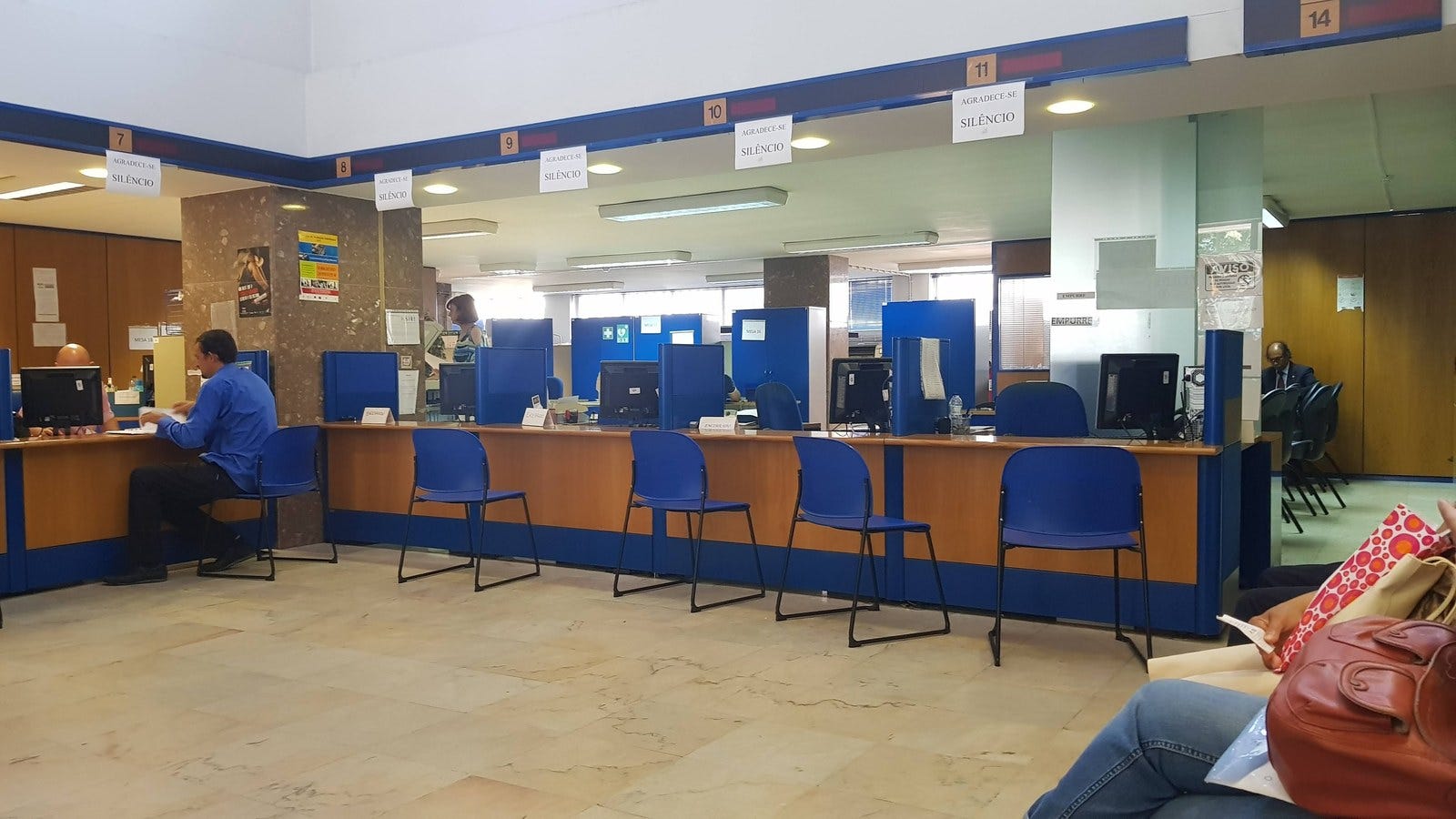
Image 1 (AIMA office) — Low-resolution (600×107) official AIMA wordmark logo, CC BY-SA 4.0./Public Portuguese government website.
Image 2 (civil registry office) — SOURCED, unchanged from 2026-08-21. conservatoria-registos-centrais-lisboa, CC0, Rakoon / Wikimedia Commons.
END