

The Carnation🌹 Revolution: How Forty-Eight Years of Dictatorship Ended in a Day
Issue No. 3 · Theme 1: History

At 00:25 on the morning of April 25, 1974, a Lisbon radio station broadcast a folk song that had been banned from Portuguese airwaves. The people who heard it knew exactly what it meant. Within eighteen hours, a dictatorship that had governed Portugal for forty-eight years was gone.
The song was “Grândola, Vila Morena” by José Afonso — outlawed under the Estado Novo because its lyrics spoke of brotherhood among ordinary people. Its broadcast on Rádio Renascença was the operational signal to rebel military units across Portugal: the coup was gone.
Seeing unfamiliar terms, people and places? Bookmark the TNIC Exam Preparation Glossary — your running reference guide for every civics term covered in all our issues.
Why it happened: a war nobody could win
The Estado Novo — António de Oliveira Salazar’s authoritarian regime — had held Portugal in place since 1933 through political police surveillance (the PIDE), press censorship, and tight control over public life. By 1974 it was governing on inertia. Salazar had suffered a disabling stroke in 1968; his successor Marcelo Caetano inherited the apparatus without the authority to reform it.
What broke the regime wasn’t ideology. It was exhaustion from war.
Since 1961, Portugal had been fighting insurgencies in Angola, Guiné-Bissau, and Moçambique simultaneously — thirteen years of three-front colonial warfare that mobilized over one million troops. Junior career officers, deployed repeatedly to those fronts, concluded the Estado Novo was asking them to die for a cause it couldn’t articulate and couldn’t end.
In September 1973, 163 of them gathered secretly — under cover of a barbecue — and founded the clandestine Movimento das Forças Armadas. Their program was three words: Democracy, Development, Decolonization. Their method: a coup, because they saw no other way. Their signal: a banned song on open radio at midnight.
The woman with the carnations
A Lisbon restaurant called Sir had ordered carnations to celebrate its first anniversary. When the owner heard the coup unfolding on the radio that morning, he closed and sent employees home with the flowers.
Celeste Caeiro, a 40-year-old cloakroom attendant and cleaner and single mother, took her carnations into the street. When a soldier signaled that he wanted a cigarette — she didn’t smoke — she handed him a carnation instead. He placed it in his rifle barrel. Others followed. The image went around the world.
The revolution had its name.
Celeste Caeiro lived until November 2024 — ninety-one years old, still a direct human link to that morning. Her death last year closed something real. Then-President Marcelo Rebelo de Sousa announced she would be decorated posthumously.
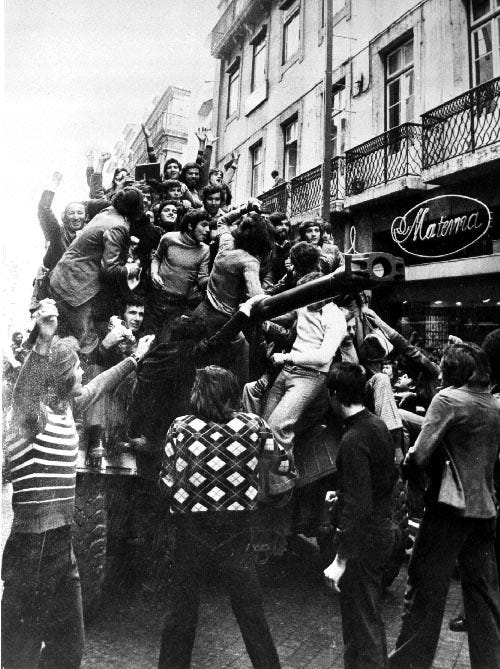
Civilians celebrate atop a military vehicle in Lisbon, April 25, 1974. Credit: Centro de Documentação 25 de Abril, CC BY 4.0, via Wikimedia Commons.
Do you know our TNIC Practice Exams are coming?
When Portugal’s implementing regulations publish — expected later in August 2026 — the official TNIC civic knowledge exam becomes real. We’re building dedicated practice exams and study materials so you can walk into that room prepared. Want to be first to know when it launches, and get free study materials along the way?
Join our TNIC Practice Exams waitlist →
Every issue between now and launch is building the knowledge base the exam will draw from. Keep reading — you’re already preparing.
Why this topic is on your citizenship exam
The Carnation Revolution isn’t background material. It’s the foundation underneath everything the TNIC should be testing.
The transition that followed — the PREC, or Processo Revolucionário Em Curso — was two turbulent years of left-right confrontation, nationalizations, and genuine uncertainty about Portugal’s direction. What emerged was the Constitution of 1976, promulgated on April 2 of that year.
That document established every institution the TNIC draws from: the Assembleia da República, the Presidency, the Constitutional Court, the Autonomous Regions of the Azores and Madeira. Its catalogue of fundamental rights — rights the Estado Novo had explicitly denied — is what Portuguese citizens carry today.
The constitution was written specifically as the answer to what April 25 ended. When an exam question asks about the rights of Portuguese citizens or the structure of the state, it is asking about choices made by people who had lived under the Estado Novo and were determined not to repeat it. That context turns a memorized fact into something you actually understand.
This week’s recap — four things to hold onto
• On April 25, 1974, the MFA overthrew the Estado Novo regime in a single day. The regime had governed Portugal since 1933, for forty-eight years.
• The true cause was thirteen years of unwinnable colonial war in Africa. The MFA’s program: Democracy, Development, Decolonization.
• The revolution took its name from the red carnations civilians placed in soldiers’ rifle barrels — beginning with Celeste Caeiro, who gave a soldier a carnation when he asked her for a cigarette.
• The Constitution of 1976, written during the two-year transition that followed, established the democratic institutions and fundamental rights for Portuguese citizens.
🌹 TNIC Quick Takes — 3 key facts to remember🌹
• The Carnation Revolution happened on April 25, 1974, when the Movimento das Forças Armadas (MFA) — 163 junior military officers organized in secret — overthrew the Estado Novo regime that had governed Portugal since 1933.
• The revolution’s name comes from the red carnations civilians placed in soldiers’ rifle barrels that morning — a symbol of peaceful change that appeared on front pages worldwide.
• The Constitution of 1976, written in direct response to the revolution, established the democratic institutions and fundamental rights the TNIC civic exam will ask you about.
Practice It
1. What was the signal that launched the revolution on the morning of 25 April 1974? (a) A radio speech by Salazar (b) The broadcast of the banned song “Grândola, Vila Morena” (c) A nationwide general strike
2. What new democratic document emerged from the revolution two years later? (a) The Constitution of 1976 (b) The Treaty of Lisbon (c) The Estado Novo charter
3. What was the group of junior officers who planned and carried out the coup called? (a) The PIDE (b) The GNR (c) The MFA
4. The revolution is named after which flower that civilians placed in soldiers’ rifle barrels? (a) Roses (b) Carnations (c) Lilies
How did you do? The answers — to this issue and every future issue’s questions— are free on our Practice Answers page to all subscribers. No need for a paid subscription, just hit FREE instead.
Start here: Issue 01 — The Five Themes | Glossary of TNIC Terms | Compare with free apps
Next Sunday — Issue 4: The Constitution of 1976
If this revolution produced the rupture. Then their constitution built what came after.
Next week we go inside the document itself — the Constituent Assembly that drafted it across eighteen months of debate, the institutional architecture it created, and the fundamental rights it committed Portugal to. If April 25 is the hinge point of modern Portuguese history, the 1976 Constitution is what the door opens onto.
Subscribe below if you haven’t yet — together is better.
The work continues. — Chris, Aspiring Lusitano
For Those with Family Members & Its Importance
A note on this short family section: the upcoming civic exam is for adults — your children aren’t required to take it. But many of us are raising young people who will become Portuguese citizens alongside us, kids who grew up outside Portugal and never sat in a classroom where this history was taught. Sharing what we’re learning at the dinner table, in the car, or on the train, is one way to pass something real to them — a courtesy to our children, not just preparation for ourselves. It also brings families a little closer to share something everyone is working toward together, even when the stakes are different for each person. I know that it’s already done that with my family.
I’m doing it with my two teenage sons now. If this section fits your family, put it in the toolkit. If not — you have less to read. Either way, the goal here is bigger than a exam: not to be a naturalized citizen on paper, but an educated, respectful, and humble citizen of not just Portugal, but the EU at large. That’s worth passing along, at any age.
→Here is a youth friendly version of what you just read:
In 1974, Portugal was ruled by a 48-year-old dictatorship. On April 25, brave soldiers peacefully overthrew it — almost no one was hurt. A woman named Celeste Caeiro gave them red carnations, which they placed in their rifle barrels. That’s how the revolution got its name. April 25 is Portugal’s Freedom Day (“Dia da Liberdade”).
Three questions to ask:
• What does it mean for a revolution to be “peaceful”?
• Why do you think soldiers put flowers where the bullets would go?
• The revolution’s signal to begin was a banned song — Grândola, Vila Morena — played on the radio. The act of playing it was the message. If you had to pick a song as a signal for something important, how would you share it was others &?
Send us their answers — we’d love to share a few next time!
Sources
All URLs verified before publication.
Primary
Centro de Documentação 25 de Abril, Universidade de Coimbra — cd25a.uc.pt
Constituição da República Portuguesa (1976) — dre.pt
Assembleia da República — Debates da Assembleia Constituinte — parlamento.pt
Sol Design Archive — Restaurante Sir
END