

🌊 The 1755 Lisbon Earthquake
🌊 What you have heard about the numbers is wrong. What makes 1755 matter is not how many died — it is what the Portuguese state did in the ten weeks after, and what it hid inside the walls. Issue 12.

New here? We’re working travelers, not history professors — learning about the history of Portugal and building the clearest English-language guide to Portugal’s new citizenship exam (the TNIC), one Sunday at a time. Today: the disaster that rebuilt Lisbon, and the parts of the story that turn out not to be true.
If you’re preparing to become Portuguese or just learn more about the country you live in or plan to— subscribe free and we’ll walk the whole TNIC exam together, week by week.
To receive past, new issues, AND all answers to my TNIC exam style questions below, consider becoming a free subscriber.
If you are here just to Practice It, there are three quick civics exam questions on this issue at the bottom.
The Short Version
On the morning of Saturday, 1 November 1755, Lisbon was at Mass. It was All Saints’ Day and the churches were full. At roughly 9:40 the ground began to move, in three shocks spread over somewhere between six and ten minutes. About an hour later the Tagus came in. Then the fire, which burned for days and did more damage to the lower city than the earthquake had.
You have probably heard a version of this in which a third of Lisbon died. That number is not real. It entered circulation through a Hamburg newspaper in December 1755 and never left. The specialist literature now puts the dead in Lisbon at roughly 10,000 to 15,000. A catastrophe, around four to nine percent of the city, and nowhere near a third.
What makes 1755 an exam-relevant event is not the body count. It is that within ten weeks a government responded to a disaster by commissioning a plan, banning private rebuilding, and mailing out a questionnaire.
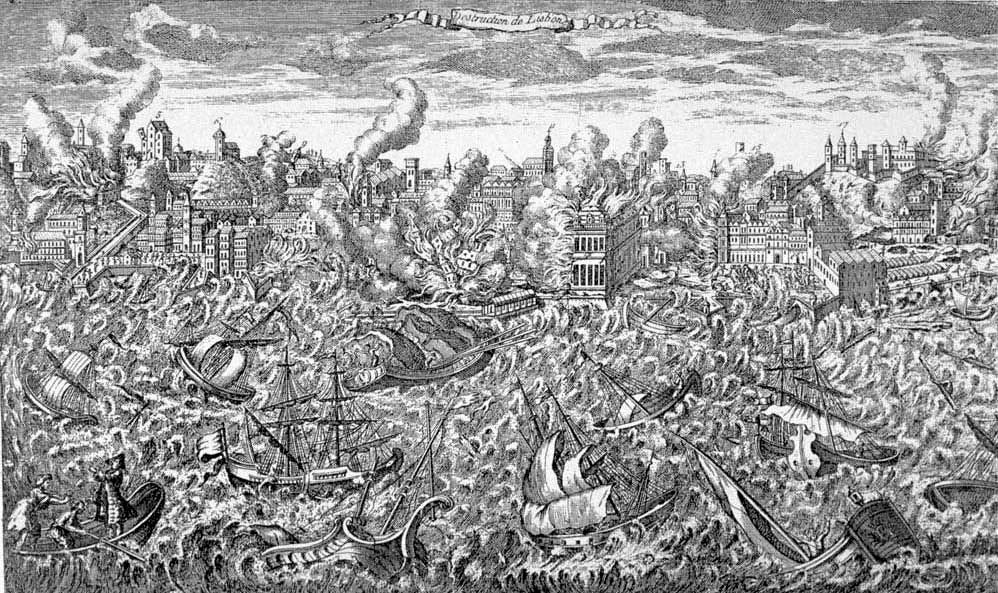
Three disasters in one morning — 1 November 1755
Three separate things destroyed Lisbon that day, in sequence, and the useful point is that they were three and not one.
The shaking. Modern estimates put the earthquake at a moment magnitude of about 8.5 to 8.7, though published figures across the last eighty years span 7.7 to 9.0 and the question is genuinely open. Note the unit: for an event this size the correct measure is moment magnitude, not the Richter scale, even though older Portuguese references still say “Richter.” The Câmara Municipal de Lisboa describes three phases over about nine minutes. Other reconstructions say six, or ten. Nobody was holding a stopwatch.
The tsunami. Not immediate. Modelling of the waves that reached downtown Lisbon puts the first arrival about 60 minutes after the shock, the second around 90, the third around 130. The first inundation hit the São Paulo parish, and only reached the Terreiro do Paço from about 65 minutes on. I learned that more than 900 people died there, caught by the water while escaping the fire. Accounts differ on whether there were two major waves or three.
The fire. This is the part the popular version undersells. The same downtown study found the earthquake alone “did not cause significant damage to most of the study area, which contradicts general knowledge.” It was the fire, burning for four to six days, that destroyed the property. Lisbon did not fall down so much as it burned down.
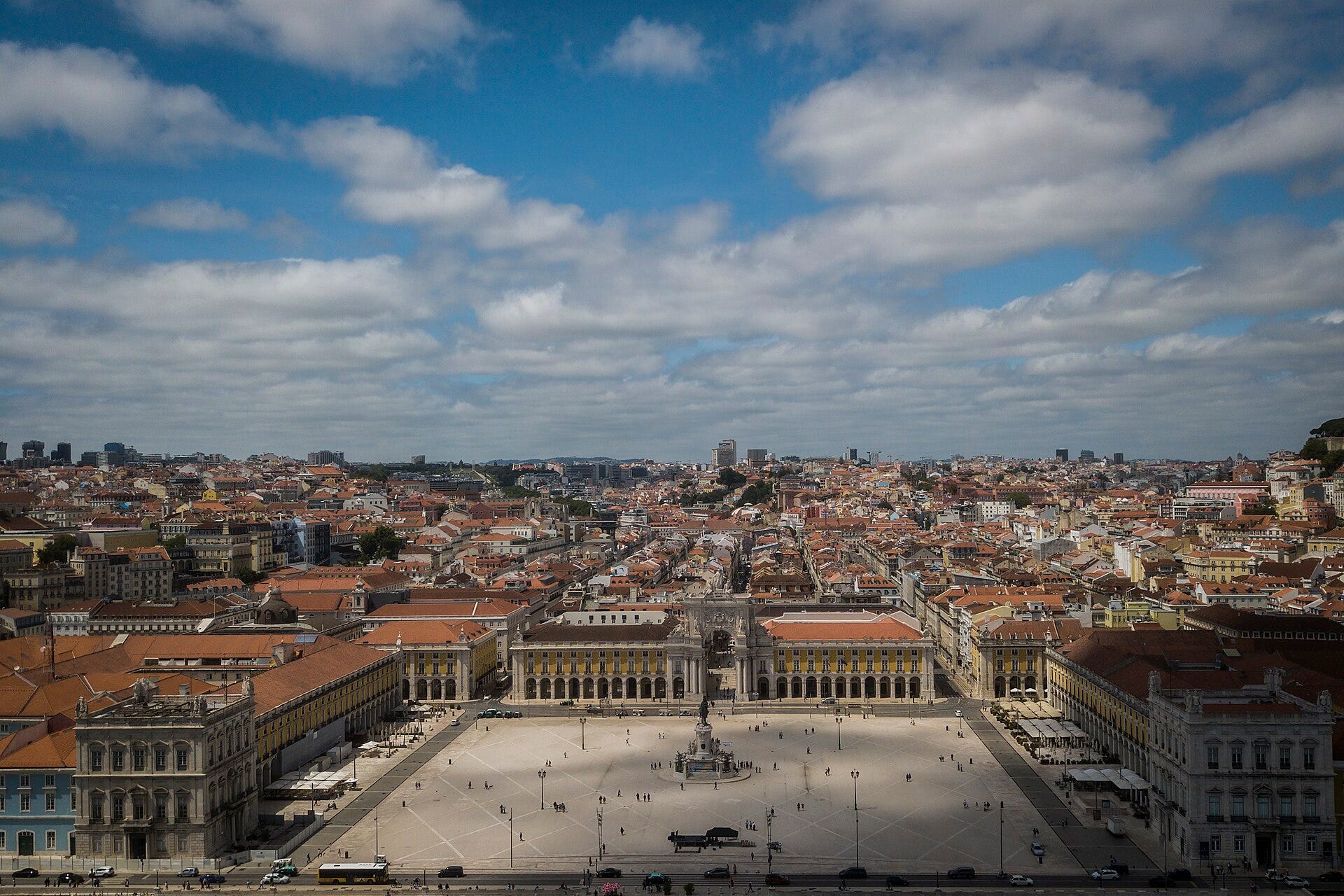
The plan that overrode private property — 4 and 5 December 1755
Manuel da Maia, engenheiro-mor do reino and then in his late seventies, delivered the first part of a long memorandum to the crown on 4 December. It set out five options for the city: rebuild exactly as it was; rebuild on the old streets but wider; rebuild wider with a two-story height limit; replan the whole site from nothing; or abandon Lisbon and build a new capital at Belém.
The fourth was chosen. If you have read that there were four options, that is a common error — there were five hypotheses in the Dissertação, and separately six competing plans drawn later, of which Eugénio dos Santos’s was picked.
The next day, 5 December, a decree barred building outside the old city. Owners could not rebuild where and how they liked. That is the decision that made the grid possible, and it is the one Christopher Wren never got in London after 1666: Wren drew a rational plan for the City, the freeholders sued, and London went back up on its medieval streets. Pombal’s plan survived because the crown overrode private title. Same disaster, same idea, opposite answer.
The design was formally approved on 12 May 1758, and land distribution on the new Rua Augusta had begun the year before. What went up was the Baixa Pombalina: a regular grid running from the riverfront square to Rossio, uniform facade heights, standardized building modules, streets wide enough that a collapsing building would not close them.
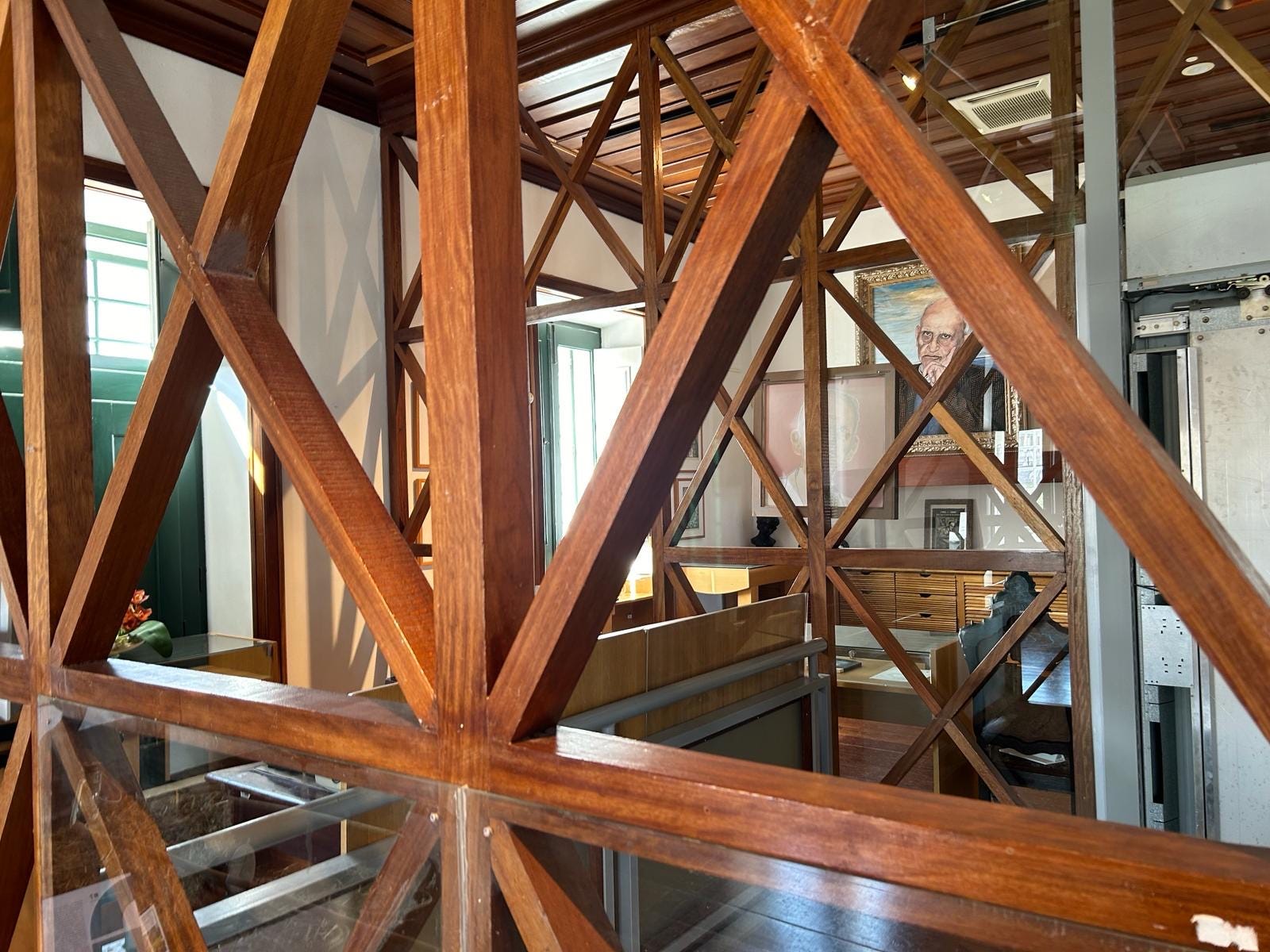
The cage inside the walls — the gaiola pombalina
The engineering is the part worth memorizing. Inside the masonry walls of a Pombaline building, above the ground floor, sits a three-dimensional timber frame: vertical posts, horizontal beams, and diagonal braces that cross to form what Portuguese engineers call cruzes de Santo André, St Andrew’s crosses. The masonry carries the weight. The timber takes the sideways forces that a masonry wall cannot. The interior walls built this way are paredes de frontal, frontal walls.
The whole system is now called the gaiola pombalina, the Pombaline cage. Here is the detail almost nobody knows: Pombal’s engineers never called it that. The word gaiola does not appear in eighteenth-century Portuguese building literature at all. The period words were frontal, armaçam and esqueleto. “Gaiola” is a retronym that only surfaced late in the nineteenth century, once photography was documenting the frames going up. The most famous term in Portuguese seismic architecture is a nickname applied a century after the fact.
The questionnaire that outlived its purpose — 1756
Ten weeks or so after the earthquake, the crown sent parish priests across the kingdom a survey of thirteen questions and told them to collect answers from their parishioners.
The questions asked when the shaking started and how long it lasted; whether the movement came harder from one direction; how many houses fell in each parish; what happened to the sea, rivers and springs; how far the water rose and how long it took to fall and rise again; whether the ground cracked; whether the shocks repeated; and what burned.
The replies survive. They sit in the Arquivo Nacional da Torre do Tombo as Ministério do Reino, maço 638, and seismologists still work from them. A 2019 paper in JGR: Solid Earth used the priests’ answers about wells and springs against modern hydrogeological data to model how the aquifers responded.
Call it what the evidence supports: the first nationwide seismological questionnaire known in Europe. Not the first in history. Spain ran a parallel inquiry into the same earthquake for Fernando VI, eight questions, answered by 1,273 towns, and no sources I found establishes which went out first.
What the popular version gets wrong
Reliability and confidence is the whole point of this newsletter, so here is where the familiar story and the evidence part company. Four items, and I checked all of them because the research notes for this issue contained three of them as fact.
“Bury the dead and feed the living” is probably not Pombal’s line. It is the single most quoted sentence in Portuguese disaster history and the attribution does not hold. An academic text from the University of Lisbon gives it to D. Pedro de Almeida, Marquês de Alorna, and notes it is “frequently attributed” to Carvalho e Melo instead. The original also has a third clause the popular version drops: e fechar os portos, and close the ports.
The Jesuits were not expelled over the earthquake. They were expelled by the law of 3 September 1759, nearly four years later, and the proximate cause was the Távora affair: the 1758 assassination attempt on King José I, after which Jesuits were accused of complicity. The earthquake belongs to the story through Gabriel Malagrida, the Jesuit who published a pamphlet in 1756 arguing the disaster was divine punishment and that no Catholic could blame natural causes. Pombal had him exiled to Setúbal for it. Malagrida was garrotted and burned in September 1761, two years after the expulsion, not as its trigger.
No soldiers marched on a model to test it. The story that troops were marched around gaiola prototypes to simulate an earthquake appears in no engineering or construction-history source I could find, including a doctoral dissertation specifically about Pombaline models. It is a good story with no documentary basis. Treat it as Portuguese folklore.
The buildings did not outperform in 1969. On 28 February 1969 an Atlantic earthquake shook Lisbon, and the popular claim is that gaiola construction proved itself. The damage surveys say the opposite: the Baixa was the worst-affected area, and among damaged buildings the Pombalino type was the most represented. Some of that reflects where Pombaline buildings are concentrated rather than how they perform, and no Pombalino collapsed. But the honest reading is that two centuries of ground-floor shopfronts cut through load-bearing walls, added stories, and renovations that expose the timber frame as decoration have degraded the system badly. The cage works. Most of the cages have been cut.
Why it matters
Lei Orgânica 1/2026 names history among the TNIC’s examinable domains, and 1755 is the hinge date in Portuguese urban history. It is why central Lisbon looks the way it does, and why the district is a candidate for UNESCO listing as Pombaline Lisbon.
Four things the exam can reasonably ask: the year 1755; Pombal’s role, and that he was not yet Marquis (that title came in 1769; he was made Conde de Oeiras in 1759); the name Baixa Pombalina; and the gaiola pombalina as the engineering system.
Getting value from this? Subscribe. This is exactly how I cover all five exam themes — plain English, fact and source driven, no fluff.
Things to remember
· The disaster was three events, not one: shaking on the morning of 1 November 1755, a tsunami arriving roughly an hour later, and a fire that burned for days and destroyed more of the lower city than the earthquake did.
· The death toll was around 10,000–15,000 in Lisbon, not the 50,000-plus you will see repeated in history books. That larger figure traces to an 18th-century newspaper rumor.
· The gaiola pombalina is a timber cage inside masonry walls, braced with St Andrew’s crosses. The name is a 19th-century invention; Pombal’s own engineers said frontal.
· In 1756 the crown sent parish priests a thirteen-question survey about the earthquake. The replies are at the Torre do Tombo and seismologists still use them.
Practice it
Three quick questions below, useful whether you’re prepping for the TNIC or just want to test what stuck. The full answer key is on the companion subscriber page; subscribe (it’s free) at the bottom of this post to see how you did.
1. Put these four events in chronological order:
(a) Manuel da Maia presents the first part of his reconstruction memorandum
(b) The earthquake strikes Lisbon on All Saints’ Day
(c) The Jesuits are expelled from Portugal and its dominions
(d) The crown sends parish priests a thirteen-question survey about the earthquake
2. What caused the greatest destruction of property in Lisbon’s lower city in November 1755?
(a) The ground shaking itself
(b) The fire that followed, which burned for several days
(c) The tsunami waves in the Tagus
(d) The demolition ordered by Pombal during clearance
3. The gaiola pombalina is best described as:
(a) The grid street plan imposed on the rebuilt Baixa
(b) A timber frame built inside masonry walls to resist sideways seismic forces
(c) The royal commission that supervised the reconstruction
(d) The height limit applied to buildings in the new lower city
How do you think you did without going back up into this issue to find the answers? Want the answer key for all the questions in all of our issues?
Click here — it’s free.
The Portugal Civics Issue is a free weekly guide to Portugal’s TNIC citizenship exam. Next Sunday: Issue 13 — Fado.
If this knowledge is helpful now and can be in your future, click here to subscribe.
The work continues.
— Chris, Aspiring Lusitano
SOURCES & VERIFICATION
THE EARTHQUAKE, TSUNAMI AND FIRE
● Magnitude, chronology and the limits of the historical record — J. Fonseca (Instituto Superior Técnico), Testemunhas do Caos, ch. 1. Gives the 8.5–8.7 mainstream band, the full published range, and the caution on chronological precision. fenix.tecnico.ulisboa.pt
● Tsunami arrival times, wave count, downtown damage attribution, Terreiro do Paço fatalities — Baptista et al. (2019), Journal of Marine Science and Engineering 7:208. Source for the 60/90/130-minute arrivals and for the finding that fire, not shaking, caused most downtown property damage. mdpi.com
● Death toll — D. Chester (University of Liverpool). States the modern revision explicitly: total Portuguese deaths “probably did not exceed 12,000,” of whom c.10,000 in Lisbon; 15,000–20,000 for Portugal, Spain and Morocco combined. https://www.researchgate.net/profile/David-Chester-6
● Time of 9:40, three phases, six-day fire — Câmara Municipal de Lisboa, Gabinete de Estudos Olisiponenses. geo.lisboa.pt
● Contemporary accounts and the conflict between them — A. C. Araújo, “The 1755 Lisbon Earthquake: The Catastrophe and the Reconstruction,” Storicamente (University of Bologna). storicamente.org
● General reference — Infopédia, “Terramoto de 1755 e reconstrução pombalina.” infopedia.pt
POMBAL AND THE RECONSTRUCTION
● Carvalho e Melo’s offices and titles — Infopédia, “Marquês de Pombal”: named Secretary of State for Foreign Affairs and War in 1750, Conde de Oeiras 1759, Marquês de Pombal 1769. infopedia.pt
● Manuel da Maia’s Dissertação, delivered 4 December 1755 — Direção-Geral da Administração e do Emprego Público. dgaep.gov.pt
● Five reconstruction hypotheses, not four; plan approved 12 May 1758 — Boletim do Arquivo da Universidade de Coimbra: “No início da Dissertação são enunciadas cinco hipóteses para a renovação de Lisboa.” impactum-journals.uc.pt. Corroborated by Cadernos do Arquivo Municipal (Lisbon). cadernosarquivo.cm-lisboa.pt
● Manuel da Maia’s formal style (mestre de campo general com exercício de engenheiro-mor do reino, from 1754) — eViterbo, NOVA FCSH. eviterbo.fcsh.unl.pt
● “Enterrar os mortos, cuidar dos vivos e fechar os portos” attributed to D. Pedro de Almeida, Marquês de Alorna — University of Lisbon repository. repositorio.ulisboa.pt
● Expulsion of the Jesuits, law of 3 September 1759; Malagrida’s 1756 pamphlet, exile, and execution in 1761 — Arquivo Nacional da Torre do Tombo virtual exhibition. antt.dglab.gov.pt
THE GAIOLA POMBALINA
● Structural description, St Andrew’s crosses, frontal walls, and the ground-floor vulnerability created by later shopfront openings — Cardoso, Lopes & Bento (ICIST/IST), 13th World Conference on Earthquake Engineering, Vancouver 2004. iitk.ac.in
● Later structural alterations — removal of interior walls and ground-floor masonry piers, added storeys, degradation — Simões, Lopes, Bento & Gago, 15WCEE 2012. iitk.ac.in
● “Gaiola” as a late-19th-century term absent from 18th-century literature; period terms frontal, armaçam, esqueleto — Mascarenhas-Mateus & Rodrigues de Castro, 8th International Congress on Construction History (2024). academia.edu
● 1969 earthquake damage: the Baixa most affected, Pombalino among the most represented damaged typologies — Vieira & Oliveira (2021), Territorium 28(II), University of Coimbra. impactum-journals.uc.pt
● Frontal-wall modelling — Couto, Bento & Carrilho Gomes, Revista Portuguesa de Engenharia de Estruturas (LNEC), Série III no. 14, Nov 2020. rpee.lnec.pt
● Pombaline Lisbon on the UNESCO tentative list, with the official description of the cross-linked frontals. whc.unesco.org
THE 1756 INQUIRY
● Thirteen questions, their content, and the Torre do Tombo holding (Ministério do Reino, maço 638) used in modern aquifer modelling — Sanz de Ojeda, Alhama & Sanz (2019), Journal of Geophysical Research: Solid Earth 124. oa.upm.es
● Full text of the thirteen questions, and the parallel Spanish inquiry of eight questions answered by 1,273 towns — Martínez Solares, Física de la Tierra (Universidad Complutense de Madrid, 2017). revistas.ucm.es
● The surviving parish replies at the Torre do Tombo — ANTT virtual exhibition, “O terramoto de 1755, a Torre do Tombo e Manuel da Maia.” antt.dglab.gov.pt
CONSTITUTION AND EXAM LAW
● Article 9(e) — Tarefas fundamentais do Estado: “Proteger e valorizar o património cultural do povo português, defender a natureza e o ambiente, preservar os recursos naturais e assegurar um correto ordenamento do território.” Verified verbatim against parlamento.pt; official consolidated text at diariodarepublica.pt
● Lei Orgânica n.º 1/2026, de 18 de maio — nationality law in force. diariodarepublica.pt
IMAGES
● Image 1 — 1755 copper engraving, Lisbon in ruins with the tsunami in the Tagus and ships foundering. Placement: after “The Short Version.” File: 1755_Lisbon_earthquake_engraving.jpg (998 × 593, 272 KB). Source: Wikimedia Commons, File:1755 Lisbon earthquake.jpg. Original held in the Museu da Cidade, Lisbon; via the Earthquake Engineering Online Archive, Jan Kozak Collection KZ128. License: Public domain (PD-old-100). No attribution required. Note: only 998 px wide — fine at column width, too small for a full-bleed header. If you want a hero image, the higher-resolution PD alternative is “Lisbone Abysmée” (1755 French etching, Bibliothèque nationale de France, 7608 × 5987, also PD, no attribution) at www.commons.wikimedia.org/wiki/File:Lisbone_Abysmée_-_estampe_-_btv1b52524679j.jpg
● Image 2 — Praça do Comércio and the Baixa grid from above the Tagus. Placement: after the December 1755 section. File: Praca_do_Comercio_Baixa_aerial.jpg (1920 × 1280, 564 KB). Source: Wikimedia Commons, File: Commerce Square (Praça do Comércio).jpg. Photo by Carlos Costa / European Commission, shot 15 May 2021. License: CC BY 4.0. Attribution required. Praça do Comércio, Lisbon. Photo: Carlos Costa / European Commission, © European Union, 2021. CC BY 4.0.
● Image 3 — exposed gaiola pombalina timber frame, St Andrew’s crosses visible. Placement: in the gaiola section. File: Gaiola_pombalina_frame.jpg (1600 × 1200, 355 KB). Source: Wikimedia Commons, File: Pombaline frame.jpg, by PatrickIzzy, 6 March 2024. License: CC0 (public domain dedication). No attribution required.
END