
How Portugal Is Governed Today 🏛️: Four Buildings, Four Powers
🗳️ A directly elected president who can't pass a single law. A prime minister the voters never directly chose. A unicameral parliament with 4 seats reserved for PT citizens living abroad. Issue No 10

New here? We’re working travelers, not professors — building the clearest English-language guide to Portugal’s new citizenship exam (the TNIC), one Sunday at a time. Today we open up the machine: who actually runs Portugal, and how the pieces fit together.
If you’re preparing to become Portuguese — as I am — subscribe free and I’ll walk the whole TNIC exam with you, week by week.
If you are here just to Practice It, there are three quick civics exam questions on this issue at the bottom.
The short version
In February 2026, a Portuguese president was elected with the largest popular vote in the country’s democratic history — 3,502,613 ballots, 66.84% of everyone who turned out. Then he took office and, constitutionally, couldn’t pass a single law on his own. Portugal hands its most-voted official a megaphone, not a lever. Understanding why is most of this issue.
The Constitution of the Portuguese Republic names exactly four “organs of sovereignty” in Article 110: the President of the Republic, the Assembly of the Republic, the Government, and the Courts. Everything else in the state — every ministry, every court, every regional government — hangs off one of these four. Portugal is what political scientists call a semi-presidential republic: a directly elected head of state shares the stage with a prime minister who answers not to the president, but to parliament.
To pass the TNIC, you don’t need every ministry or every acronym. You need four buildings and what happens inside each one.
The four organs of sovereignty
Four bodies. Four different jobs. None of them can do the others’ work.
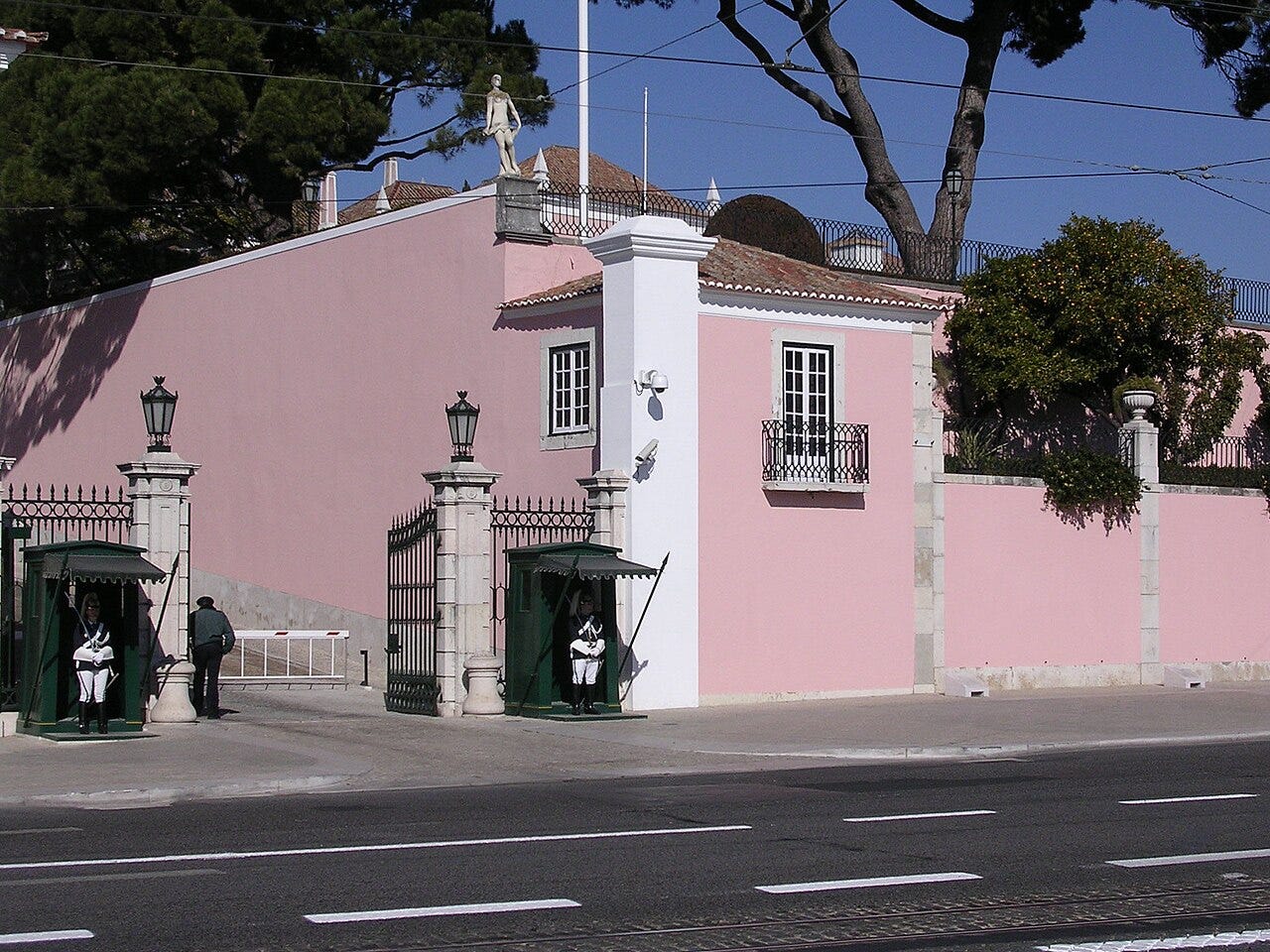
· The President — Belém Palace. Directly elected by universal, direct and secret suffrage (Article 121), for a five-year term (Article 128), and limited to two consecutive terms (Article 123). The President promulgates or vetoes laws, commands the armed forces, and can dissolve the Assembly (Article 133) — but holds no direct executive power. The current President is António José Seguro (PS), sworn in 9 March 2026, succeeding Marcelo Rebelo de Sousa. Portuguese constitutional theory calls this role a poder moderador — a moderating power, closer to referee than ruler.
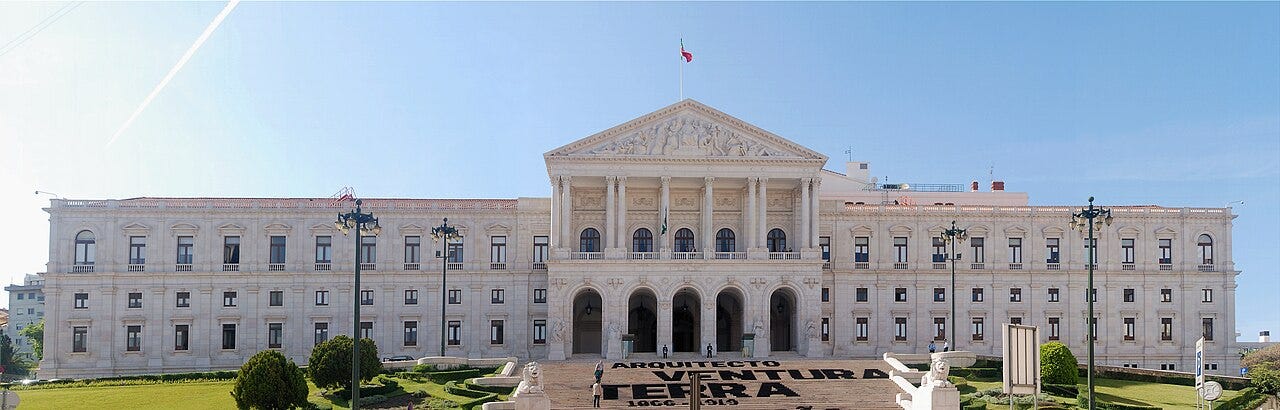
· The Assembly of the Republic — Palácio de São Bento. A single chamber of 230 deputies, elected by proportional representation using the D’Hondt method (Article 149) for four-year terms. Worth knowing precisely: the Constitution does not fix the number at 230 — Article 148 sets a range of “no fewer than 180 and no more than 230 Deputies, as provided by electoral law,” and it is the electoral law (Lei n.º 14/79, Article 13) that pins it at 230. The Assembly writes the laws, approves the state budget, and can bring down the Government with a vote of no confidence. Its current President — the speaker — is José Pedro Aguiar-Branco (PSD), re-elected 3 June 2025 at the opening of the XVII Legislature.
· The Government — next door to São Bento. Led by the Prime Minister (PM), the Government (formally the Council of Ministers) is the body that actually administers the country day to day, and it is politically responsible to the Assembly (Articles 190–191) — meaning it governs only as long as parliament tolerates it. The Prime Minister is Luís Montenegro (Social Democratic Party-PSD Partido Social Democrata, leading the Democratic Alliance-AD coalition), heading the XXV Constitutional Government, sworn in 5 June 2025. The President appoints the PM “in light of the election results” — he does not pick freely.
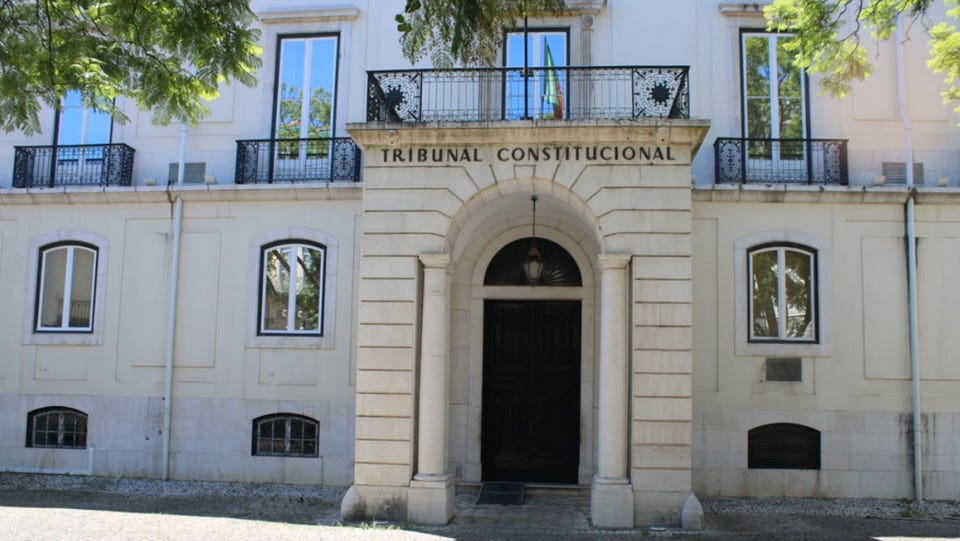
· The Courts — Ratton Palace. Specifically the Constitutional Court, which can strike down laws the other three organs produce. Article 222 gives it 13 judges — 10 designated by the Assembly and 3 co-opted by those ten — each serving a single, non-renewable nine-year term. The two-thirds supermajority the Assembly needs to elect its ten is not in the Constitution; it comes from the Court’s own statute (Lei n.º 28/82, Article 12). On 15 June 2026 the plenary elected João Carlos Loureiro as its new president, with Rui Guerra da Fonseca as vice-president.
One structural note: this issue is titled “Four Buildings, Four Powers,” and three images cover three buildings. The fourth — the Government — is the one that has no building of its own to show. That is a real fact about how Portugal is arranged, not a gap in the image plan.
One more piece worth holding onto: Portugal is a unitary state, not a federation — but the Azores and Madeira are constitutional Autonomous Regions (Articles 6, 225–234), each with its own elected Legislative Assembly, its own Regional Government, and its own political-administrative statute. It’s a layer of self-rule the mainland’s districts simply don’t have.
Why it matters for your exam
Lei Orgânica 1/2026 names “the political organization of the Portuguese State” as one of the five subjects the TNIC tests — and it is the one the exam can test most literally: who does what, chosen how, for how long.
For anyone navigating residency, it’s the Government — not the President — that runs immigration through AIMA, and it’s the Assembly, not the courts, that writes nationality law. Knowing which of the four buildings actually decides your case tells you which door to knock on.
The four numbers worth keeping in your head: 1 President (5-year term, up to 2 in a row), 230 deputies (4-year terms), 1 Prime Minister answerable to those 230, and 13 judges (9-year terms) who can overrule the other three. If those four numbers map cleanly to four bodies for you, you have the spine of this theme.
Getting value from this? This is exactly how we cover all five exam themes — plain English, real sources, no fluff. It’s free. Subscribe, and bring a friend who’s also going through it.
Test Prep Materials
Five things to remember
· Four organs of sovereignty, named in Article 110: the President, the Assembly, the Government, the Courts. Nothing else in the state outranks these four.
· Portugal is semi-presidential — a directly elected President with real but limited powers (promulgate/veto laws, dissolve the Assembly, command the military), alongside a Prime Minister who actually runs the country and answers to Parliament, not the President.
· 230 deputies, one chamber. The Assembly of the Republic is unicameral, elected by proportional representation, and it’s the only body that can make law or bring down a government. The Constitution sets the range (180–230); the electoral law fixes the number.
· 13 judges can overrule everyone else. The Constitutional Court — 10 designated by the Assembly, 3 co-opted — reviews whether laws the other organs pass are actually constitutional.
· Two islands, real self-rule. The Azores and Madeira are Autonomous Regions with their own elected legislatures and governments — a unitary state with a genuine exception built into its Constitution.
Practice it
Three quick questions below, useful whether you’re prepping for the TNIC or just want to test what stuck. The full answer key is on the companion subscriber page; subscribe (it’s free) at the bottom of this post to see how you did.
1. Which body has the power to make laws and approve the State Budget?
(a) The President of the Republic
(b) The Assembly of the Republic
(c) The Constitutional Court
(d) The Council of State
2. How many judges sit on the Constitutional Court, and how many of them are designated by the Assembly of the Republic?
(a) 11 total, 7 designated
(b) 13 total, 10 designated
(c) 15 total, 12 designated
(d) 13 total, all designated by the Assembly
3. How many seats in the Assembly of the Republic are reserved for Portuguese citizens living abroad?
(a) None — emigrants vote in their home district
(b) Two, for the Europe circle only
(c) Four — two for Europe, two for outside Europe
(d) Ten, one per major host country
How do you think you did without going back up into this issue to find the answers? Want the answer key for all the questions in all of our issues?
The Portugal Civics Issue is a free weekly guide to Portugal’s TNIC citizenship exam. Next Sunday: Issue 11: Your Rights and Duties as a Portuguese Citizen
If this knowledge is helpful now and can be in your future, click here to subscribe.
The work continues.
— Chris, Aspiring Lusitano
SOURCES & VERIFICATION
CONSTITUTION OF THE PORTUGUESE REPUBLIC
PRESIDENT OF THE REPUBLIC
● António José Seguro — President since 9 March 2026 — Presidência da República. presidencia.pt — Conheça o Presidente da República. Elected in the second round of the 2026 presidential election with 3,502,613 votes (66.84%), the highest vote total ever recorded for a candidate in a Portuguese presidential election. Succeeded Marcelo Rebelo de Sousa.
GOVERNMENT
● Luís Montenegro — Prime Minister, XXV Constitutional Government — Governo de Portugal. portugal.gov.pt — Primeiro-Ministro.
● XXV Constitutional Government sworn in 5 June 2025 — Governo de Portugal. portugal.gov.pt — XXV Governo Constitucional tomou posse. Sixteen ministers, sworn in at the Palácio Nacional da Ajuda before President Marcelo Rebelo de Sousa.
ASSEMBLY OF THE REPUBLIC — PRESIDENCY
● José Pedro Aguiar-Branco — President of the Assembly — Assembleia da República. parlamento.pt — Presidente da XVII Legislatura. Re-elected 3 June 2025 at the opening of the XVII Legislature.
CONSTITUTIONAL COURT
● João Carlos Loureiro — President of the Constitutional Court since 15 June 2026 — Tribunal Constitucional. tribunalconstitucional.pt — Juízes / Plenário. Elected by the plenary on 15 June 2026, with Rui Guerra da Fonseca as Vice-President, on the same day four newly elected judges took office.
Images
● Image 1 — Palácio de Belém (official residence of the President)
Placement: Within the body, adjacent to the President bullet in “The four organs of sovereignty.”
Source file: Wikimedia Commons — Lisboa, Palácio Nacional de Belém (1).jpg
.jpg)
Citation: De Paepe edwin. Published on Wikimedia Commons.
License: CC0 / public domain dedication. Free for all uses including commercial, no attribution required.
● Image 2 — Palácio de São Bento (seat of the Assembly of the Republic)
Placement: Within the body, adjacent to the Assembly bullet.
Source file: Wikimedia Commons — Parlamento April 2009-1a.jpg

Citation: Alvesgaspar, via Wikimedia Commons.
License: CC BY-SA 3.0. Attribution required; share-alike.
● Image 3 — Palácio Ratton (seat of the Tribunal Constitucional)
Placement: Within the body, adjacent to the Courts bullet.
Source file: Wikimedia Commons — Palácio Ratton.png

Citation: Novo Liceu, via Wikimedia Commons.
License: CC BY 3.0. Attribution required.
END