

Dia de Portugal (Portugal Day), de Camões e das Comunidades Portuguesas
SPECIAL EDITION 1 • June 10 2026

Today Portugal stops. On June 10, 1580, Luís de Camões — the country’s greatest poet — took his last breath in Lisbon. He left behind one masterpiece, a nation’s worth of lyric poetry, and a legacy so enormous that four centuries later, an entire country marks the anniversary of his death as its national day.
If you are on the path to Portuguese citizenship, you will meet Camões on the TNIC exam. But even if you aren’t, his story is worth knowing. It is, in many ways, the story of Portugal itself.
Start here: Issue 01 — The Five Themes | Glossary of TNIC Terms | Compare with free apps
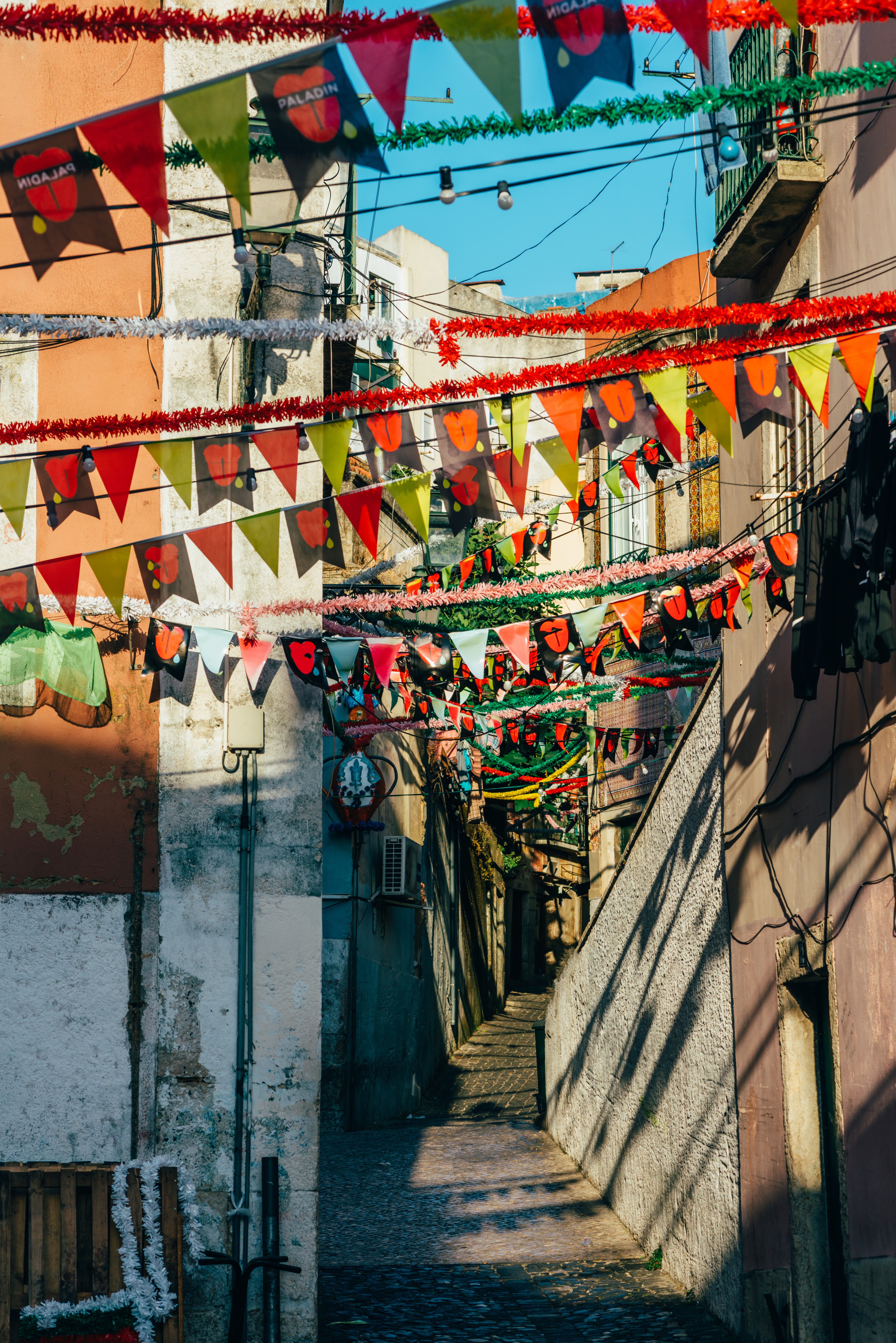
Traditional bunting and street decorations fill a narrow lane in Mouraria, Lisbon, during the celebrations. Licensed via Adobe Stock.
The Man and the Poem
Luís de Camões was born around 1524 in Lisbon, into minor nobility. He was educated in the classics, wrote poetry in the tradition of Petrarch, and — in very un-poet fashion — lost an eye fighting in North Africa and spent time in jail for brawling with a royal official in the streets of Lisbon.
He was eventually pardoned and shipped off to India, where he spent seventeen years in the Portuguese colonial world. He nearly drowned off the coast of Macau and, according to legend, saved his manuscript by swimming to shore with one arm while holding the pages above the water with the other.
That manuscript was Os Lusíadas — The Lusiads — published in 1572. The title comes from Lusitania, the ancient Roman name for Portugal. The poem tells the story of Vasco da Gama‘s voyage to India, but it is really something larger: an epic celebration of Portuguese courage, exploration, and identity, modeled consciously on Virgil’s Aeneid. The poem runs 1,102 stanzas across ten cantos. It is dense, beautiful, and demanding — and it is as central to Portuguese culture as Homer is to the Greeks.
Camões died the same year the Battle of Alcântara handed Portugal to Spain. He reportedly said: “I loved my country so much that I will die with it.” He died in poverty. The timing was brutal and the irony complete.
Read “Os Lusíadas” free English translation (Mickle, 1776) → |
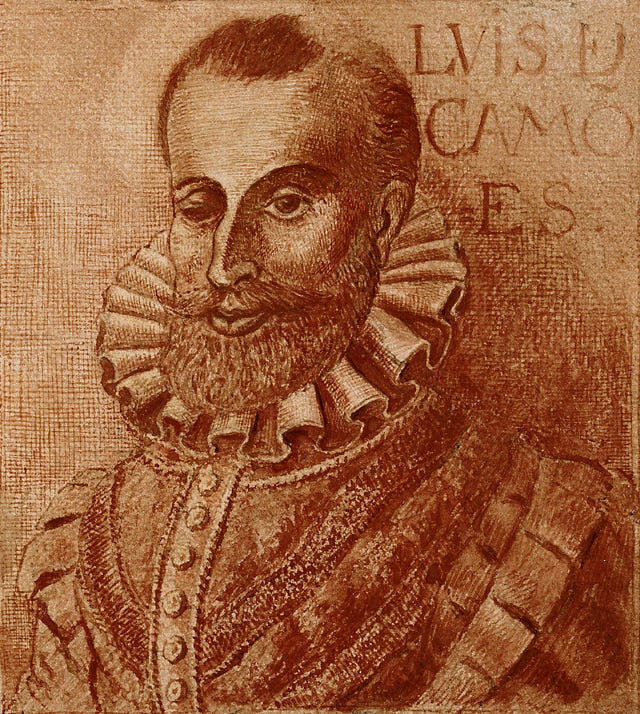
Portrait of Luís de Camões (c. 1524–1580), attributed to Fernão Gomes, c. 1577. Public domain. Source: Wikimedia Commons.
The Holiday
Dia de Portugal’s full official name is Dia de Portugal, de Camões e das Comunidades Portuguesas — Day of Portugal, of Camões, and of the Portuguese Communities. That last phrase matters. This is explicitly a holiday for the diaspora, not just residents of Portugal.
It was not always called this. Under Salazar’s Estado Novo dictatorship, June 10 was called Dia da Raça — Day of the Race — a name that carried the nationalist and imperial ideology of the regime. After the Carnation Revolution of 1974 ended the dictatorship, the holiday was renamed and reframed: away from imperial pride, toward a more inclusive celebration of Portuguese identity worldwide.
The official government ceremony rotates each year to a different Portuguese city or region. In 2026, it is being held on Terceira Island in the Azores — a nod to the islands’ 50 years of regional autonomy. Overseas, the official commemorations are centered in Luxembourg, home to one of the largest Portuguese communities in Europe.
How Portugal Celebrates
For a national holiday, June 10 is not quiet. If you are lucky enough to be in Portugal this week, here is what you will find:
Street festivals (arraiais) everywhere. Every neighborhood puts out tables, strings lights, and grills sardines. The smell of sardinhas assadas drifting through the streets is as Portuguese as the flag. Grilled sardines and cold beer are the unofficial meal of the day.
Fado in the air. Fado — Portugal’s UNESCO-recognized music of longing and saudade — plays in restaurants, bars, and open squares. This is the season for it.
Santos Populares. June 10 falls in the middle of the Santos Populares season — the month-long popular saints’ festivals that run through June in northern Portugal and peak in Lisbon around Santo António (June 13). The streets of Alfama, Mouraria, and Bairro Alto become open-air parties.
Bacalhau and pastéis de nata. A proper Portuguese celebration table includes bacalhau — salt cod, prepared in a hundred ways — and pastéis de nata, the custard tarts first made by monks at the Jerónimos Monastery in Belém in the early 19th century.
Diaspora events globally. From Paris to Newark to São Paulo to Toronto, Portuguese community associations hold their own Dia de Portugal dinners, concerts, and parades. The holiday is genuinely transnational.
Why This Matters for the TNIC Exam
The exam is called the Teste Nacional de Integração e Cidadania — the National Test of Integration and Citizenship — and understanding why a country chose a poet’s death date as its national day is exactly the kind of integration the exam is looking for.
For exam-preppers: Know the full official name — Dia de Portugal, de Camões e das Comunidades Portuguesas — and the date: 10 June. Know that it marks the death of Camões in 1580, not a battle or a founding.
For residents: The holiday’s arc — from imperial commemoration to Dia da Raça to post-revolutionary civic observance — mirrors Portugal’s entire 20th-century political history. That kind of context is exactly what the TNIC exam is expected to test.
For the diaspora and the curious: Portugal has always been a country that explores. Its national epic is about a voyage. Its national day includes the people who are not there. Citizenship, for Portugal, is not only about where you live. It can also be where you bring it.
TNIC Quick Take
• Dia de Portugal, de Camões e das Comunidades Portuguesas is observed on 10 June each year; it marks the death of Luís de Camões on 10 June 1580
• Camões authored Os Lusíadas (published 1572), Portugal’s national epic, which narrates Vasco da Gama’s voyage to India
• The holiday’s current democratic form — with Comunidades Portuguesas in the name — was established in 1978, four years after the Carnation Revolution
Today Portugal observes itself — not just its borders, but its language, its departed, its reach beyond its borders.
The work continues. — Chris, Aspiring Lusitano
Do you know the TNIC Practice Exams and Study Materials are coming?
When Portugal’s implementing regulations publish for the new civics exam — expected later in August 2026 — the official TNIC civic knowledge exam becomes real. We’re building dedicated practice exams and study materials so you can walk into that room prepared. Want to be first to know when it launches, and get free study materials along the way?
Join the TNIC Practice Exams waitlist
Already subscribed to this Substack? You’re ahead. Every issue between now and launch is building the knowledge base the exam will draw from. Keep reading — you’re already preparing.
If you’re not, subscribe free